

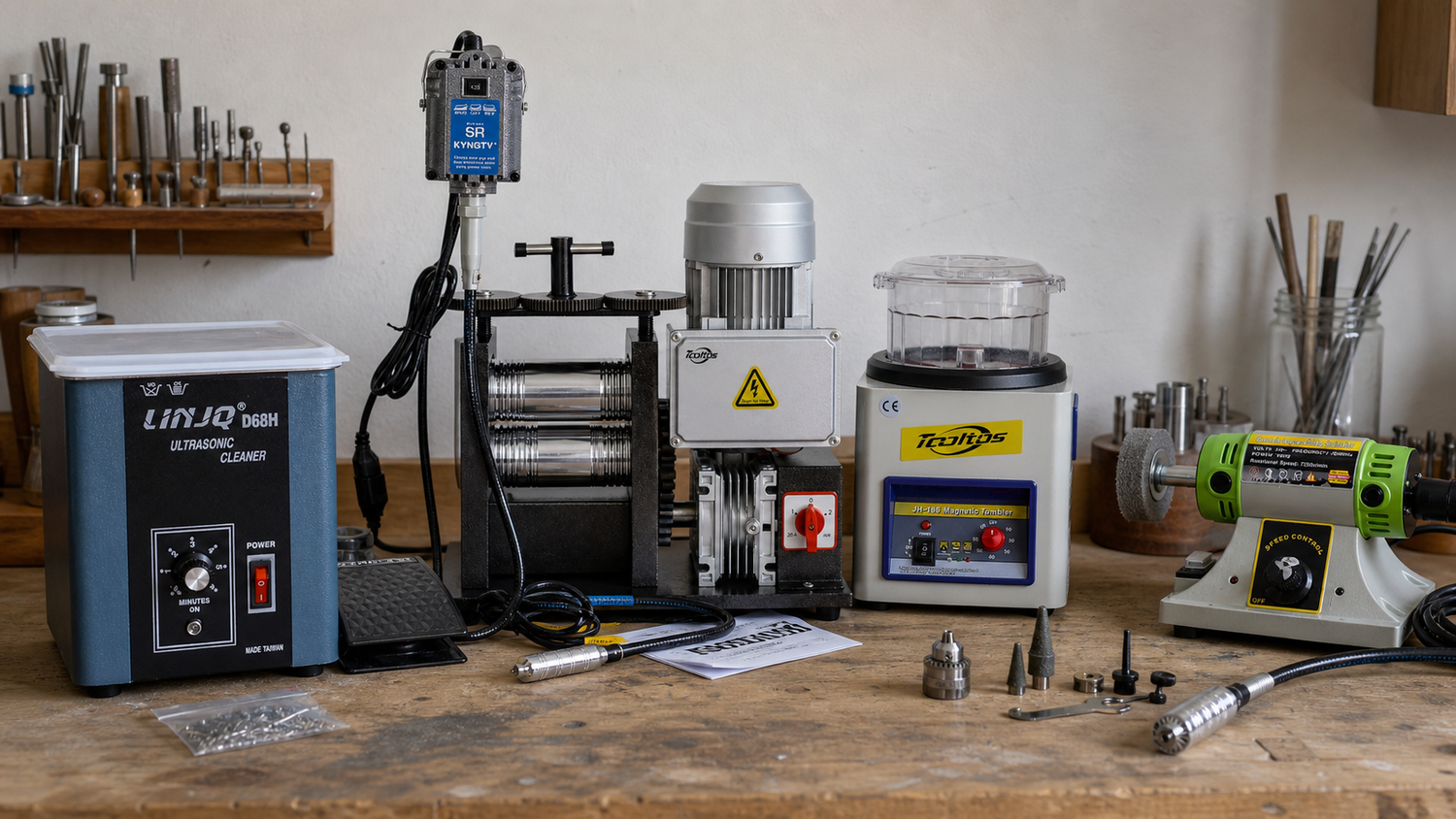
Many jewelry creators focus entirely on upgrading their skills — but overlook how much the right tools shape the final result. Even devices from the same brand serve distinct purposes and suit different working styles.
After years of hands-on jewelry making, one thing is clear: there is no single "best" tool. Every professional device is built for specific production scenarios, with its own strengths and limitations. The real skill is matching your tools to your craft habits.
This guide offers a practical, side-by-side comparison of Tooltos professional jewelry devices — based on real crafting experience — to help you avoid wrong purchases and steadily improve your finished quality.
1. Welding Machine Comparison
Both are widely used for jewelry splicing and repair, but they use different welding technologies suited to different precision requirements.
Tooltos 30A Pulse Jewelry Spot Welder For Gold, Silver And Platinum
Best for: Everyday welding and beginner practice. Simple to operate with stable power output and a low learning curve. Performs reliably for chain connections, clasp assembly, and standard thin-to-thick metal splicing. Ideal for high-frequency basic welding tasks with minimal equipment wear.
Limitation: Ultra-fine or high-precision precious metal work. For ultra-thin silver sheets or micro-detail splicing, precision is constrained and additional polishing is typically needed after welding.
Tooltos 50A Pulse Jewelry Spot Welder For Gold, Silver And Platinum
Best for: High-precision fine jewelry welding and complex repair. Pulse technology delivers an ultra-small fixed-point heating zone, effectively preventing oxidation, blackening, and solder joint bulging on gold and silver. Weld seams come out flat and smooth, significantly reducing post-weld polishing time.
Limitation: Overkill for simple thick-material welding. In low-difficulty scenarios, the high-precision configuration adds cost without adding value.
How to Choose
- Choose the 30A Spot Welder for daily basic welding, beginner practice, and conventional accessory assembly.
- Choose the 50A Pulse Spot Welder for fine precious metal work, ultra-thin material splicing, and high-standard repair jobs.

2. Polishing Device Comparison
These two finishing devices work on different principles and complement each other in a complete polishing workflow.
Tooltos 7200RPM Multi-purpose Bench Lathe Jewelry Polishing and Grinding Machine
Best for: Targeted surface grinding and brightening. The high-speed rotating polishing wheel efficiently removes tool marks, shallow scratches, and edge burrs from open jewelry surfaces — quickly restoring a bright, flat finish and clean contour lines.
Limitation: Cannot reach hidden areas. Narrow gaps, inner walls, and inlay recesses are beyond its reach, leaving internal oxidation and hidden burrs unaddressed.
Tooltos JH-185 Magnetic Tumbler Jewelry Polishing Machine | 2000RPM 600g
Best for: 360° all-round deep finishing with no dead angles. Magnetic grinding pins flow freely through the workpiece, reaching every gap, groove, and inner wall. Thoroughly removes internal oxidation layers, welding traces, and micro burrs — leaving the overall texture uniform and refined throughout.
Limitation: Slow surface brightening. It cannot replicate the rapid localized grinding and edge trimming of a bench polisher.
How to Choose
- Use the Bench Lathe Polisher for surface brightening, edge trimming, and open-surface flaw removal.
- Use the Magnetic Tumbler for complex hollow structures, inlaid pieces, and overall deep finishing.
3. Metal Shaping Comparison
Both belong to the Tooltos professional metal shaping series, but their functional configurations suit very different creation styles.
Tooltos Electric Flat Sheet Jewelry Rolling Mill | 120mm / 160mm
Best for: Flat sheet metal processing. Delivers single, stable mechanical pressure with high flatness precision. Simple structure, easy to maintain, and low daily wear — an excellent choice for creators whose primary style centers on flat metal jewelry.
Limitation: Single processing dimension. Wire drawing and shaped metal rolling are not supported, so additional equipment is needed for diversified shaping work.
Tooltos 160mm 750W 4-in-1 Electric Jewelry Rolling Mill
Best for: Creators who need versatility. Integrates four core shaping functions in one machine: flat sheet, round wire, half-round wire, and square wire processing. Eliminates process errors from frequent equipment changes with strong compatibility for diverse creation styles.
Limitation: Slightly lower flat-rolling accuracy compared to a dedicated single-function model, due to the multi-functional structural design.
How to Choose
- Choose the Flat Sheet Rolling Mill for creators focused on flat sheet jewelry design.
- Choose the 4-in-1 Rolling Mill for creators who regularly switch between sheet and wire shaping.

4. Precision Finishing Comparison
Both are terminal finishing tools for improving jewelry fineness — one handles physical trimming, the other handles deep cleaning.
18000RPM Jewelry Hang-Up SR Flex Shaft Motors Rotary Tool
Best for: Partial fine trimming and detail polishing. The flexible shaft adapts to curved surfaces and narrow gaps, precisely trimming tiny burrs, repairing uneven solder joints, and polishing localized rough areas. The go-to tool for manual precision detail work.
Limitation: Surface physical flaws only. It cannot remove invisible dirt, oil residue, or micro-oxidation inside gaps.
Tooltos D68H Jewelry Ultrasonic Cleaning Machine
Best for: Micro deep cleaning. High-frequency vibration breaks down polishing dust, metal debris, and oil residues in workpiece gaps and grooves — without damaging the polished surface. Effectively restores the pure, transparent metallic luster of finished jewelry.
Limitation: No physical repair capability. It cannot improve surface flatness or smoothness.
How to Choose
- Use the Flex Shaft Rotary Tool for detail trimming, burr removal, and localized surface polishing.
- Use the Ultrasonic Cleaning Machine for post-production deep cleaning and luster restoration.
Core Tool Selection Logic
Every Tooltos professional device has a precise positioning — no redundant configuration, no functional gaps. Each is developed for specific craft stages and creation needs.
The takeaway from these comparisons: there is no universally superior equipment in handmade jewelry. Single-function tools offer high precision and stable performance — ideal for creators with a fixed, consistent style. Multi-functional tools prioritize efficiency and versatility — better suited for creators who explore a range of techniques.
Matching tools to your actual craft habits is what optimizes your workflow and finished quality. The right combination lets every creator fully express their design vision and craftsmanship.
Final Thoughts
Improving your craft depends on both skill development and smart tool selection. Understanding the differences between professional devices is the foundation of a standardized, upgradeable workflow.
For jewelry makers at any level, continuous skill growth matters — but so does choosing tools that genuinely fit how you work. I hope this comparison guide helps you find the right tool combination for your making style.

0 comments