

A practical guide to equipment roles, production workflow, temperature holding, and studio capacity planning
If you are new to lost wax casting, or upgrading a small jewelry studio, you may see two types of ovens marketed for flask preparation: a programmable burnout kiln and a smaller flask holding or preheat oven. It is easy to assume that both are required for professional casting, but that is not how most small-studio workflows are organized.
A properly sized, programmable burnout kiln can handle every thermal stage of flask preparation — from controlled wax removal and high-temperature burnout to cooling and holding the flask at its final casting temperature. A separate flask holding oven is an optional production tool that can improve scheduling, separate temperature zones, and free the main kiln for another batch. It is not automatically required to achieve a sound casting.
This guide explains what each oven is designed to do, how the equipment fits into a standard casting workflow, and when a second holding oven can provide a practical return for your studio.
Quick Summary: The Core Difference
A burnout kiln prepares invested flasks through the complete programmed heating cycle and can also perform the final casting-temperature hold; a flask holding oven keeps already burned-out flasks ready for pouring and primarily improves production flow.
For most independent jewelers and small studios, one correctly operated programmable burnout kiln is sufficient. A separate holding oven becomes useful when production schedules overlap, multiple flask temperatures are needed, or the main kiln must begin the next burnout cycle before all flasks from the previous batch have been cast.
The term "casting furnace" is ambiguous. In many professional catalogs it refers to metal-melting equipment or equipment associated with the casting operation, while some sellers also use it for burnout ovens. For an oven used only to maintain flask temperature, "flask holding oven" or "flask preheat oven" is clearer.
What Is a Jewelry Burnout Kiln?
A jewelry burnout kiln — also called a burnout oven or dewaxing kiln — is the main heating unit used to prepare invested flasks for lost wax casting. It is designed to run a controlled, multi-stage program rather than simply heat the chamber to one temperature.
- Early-stage wax removal: Many wax-based schedules include a controlled hold near 150°C (300°F) so bulk wax can drain from the flask without rapid steam generation or unnecessary thermal stress. The exact loading method and early hold must follow the investment manufacturer's instructions.
- Residual burnout: The kiln then follows the specified ramp to remove remaining wax and combustible residue. For compatible castable resins or other pattern materials, longer or different schedules, specialized investment, and additional ventilation may be required.
- Peak-temperature burnout and thermal conditioning: The flask is held at the investment manufacturer's specified peak temperature to complete pattern removal, reduce residual carbon, and bring the mold to the required thermal condition. Many jewelry-grade gypsum-bonded investment schedules peak around 630–730°C (1166–1346°F), but some products specify lower maximum temperatures.
- Final casting-temperature hold: After peak burnout, the kiln cools to the flask temperature recommended for the selected alloy and casting method. The flask remains at that temperature long enough for its core temperature to equalize before pouring.
Key Specifications to Evaluate
- Controller: A programmable ramp-and-hold controller with enough segments for the investment manufacturer's schedule. PID control can support stable holding, but overall performance also depends on calibration, sensor location, chamber design, and load.
- Equipment temperature rating: Jewelry burnout kilns are commonly rated to approximately 800–1100°C (1472–2012°F). This is the equipment limit, not a universal burnout temperature. The actual program must be based on the investment and pattern material.
- Capacity and airflow: The chamber must provide adequate clearance around flasks, appropriate support above the kiln floor, and airflow for wax drainage and combustion by-products.
- Ventilation: Burnout can release wax, resin, and investment fumes. Use the exhaust or ventilation arrangement specified by the kiln and investment manufacturers, and comply with applicable workplace requirements.
- Temperature uniformity: A well-designed, properly calibrated kiln should maintain a stable final hold, but displayed temperature does not guarantee identical temperature at every chamber location or inside every flask.
A common misconception is that a burnout kiln cannot hold stable mid-range temperatures. Many well-designed and properly calibrated jewelry burnout kilns can maintain the final flask-holding temperature reliably. The key variables are controller performance, thermocouple condition and placement, chamber uniformity, loading, door-opening frequency, and adequate equalization time.
Dual PID Jewelry Burnout Furnace 800°C for Wax Casting — Programmable dual PID controller, designed for multi-stage jewelry burnout schedules.
What Is a Flask Holding Oven?
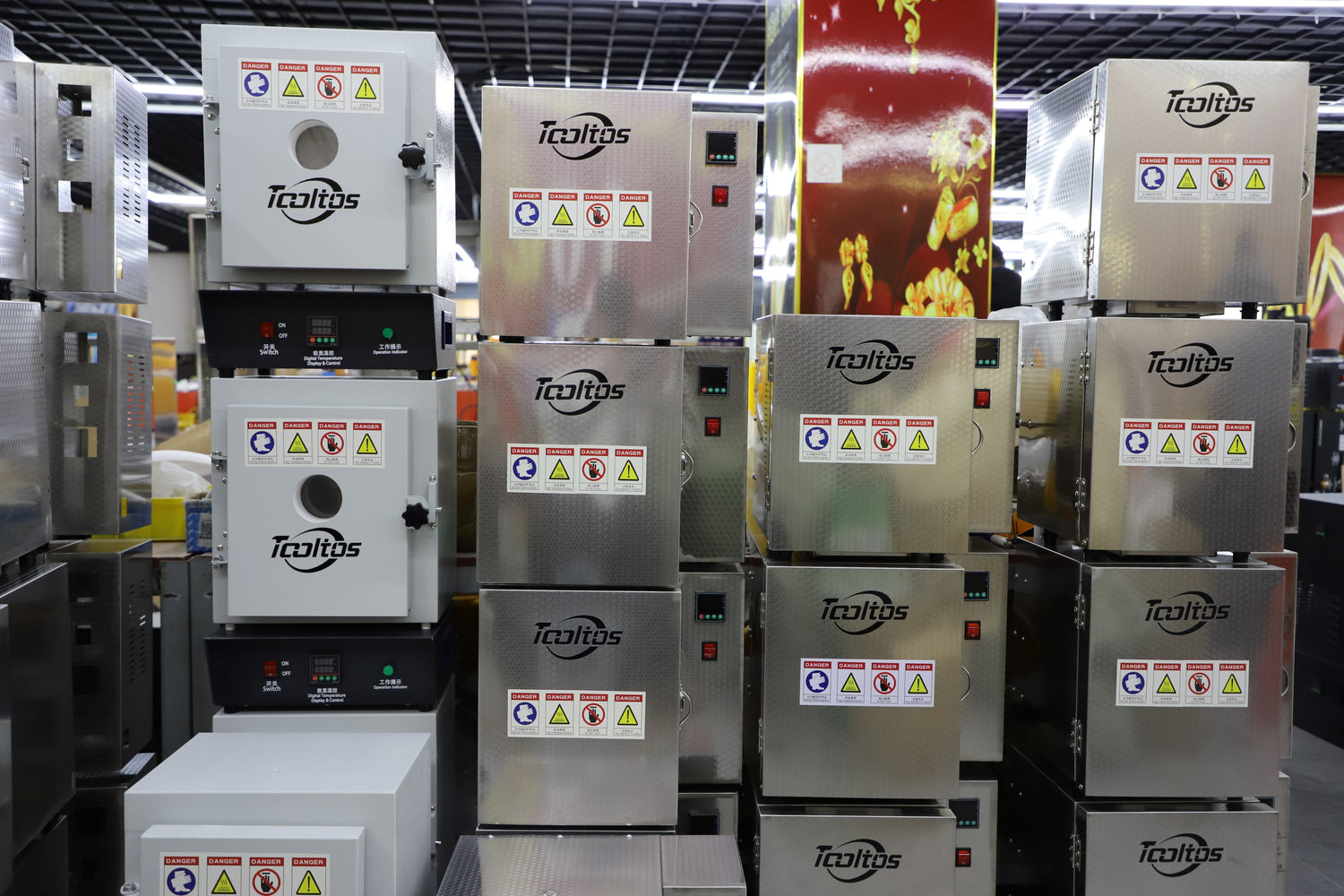
A flask holding oven, sometimes called a flask preheat oven, is a smaller secondary oven used to maintain fully burned-out flasks at a selected casting temperature until the metal and casting machine are ready. It is a workflow tool, not a replacement for a properly equipped burnout kiln.
- Hold ready-to-cast flasks: Maintain flasks that have already completed the full burnout program in the main kiln.
- Free the main burnout kiln: Allow the main kiln to cool, be cleaned if necessary, or begin the next programmed batch while previous flasks remain ready for casting.
- Create separate temperature zones: Hold different groups of flasks at different temperatures when alloys, design thicknesses, or production schedules require separate conditions.
- Improve access and scheduling: A compact chamber can simplify one-at-a-time flask retrieval during a long casting session and reduce unnecessary openings of the main burnout kiln.
A holding oven should not be used for full wax or resin burnout unless the manufacturer explicitly designs and approves it for that purpose. Even when its maximum temperature appears high enough, a holding-only oven may lack the programmed ramp-and-hold capability, wax drainage arrangement, combustion airflow, exhaust provisions, and chamber protection required for safe and complete burnout.
Jewelry Flask Preheating Furnace 1150°C with Observation Window — Stable holding temperature with observation window for monitoring flasks without opening the door.
Dual PID Jewelry Burnout Furnace 800°C for Wax Casting — Programmable dual-temperature controller for precise multi-stage burnout and flask holding schedules.
Side-by-Side Comparison
| Feature | Programmable Burnout Kiln | Flask Holding / Preheat Oven |
|---|---|---|
| Primary purpose | Complete programmed flask preparation: wax removal, burnout, thermal conditioning, cooling, and final temperature hold | Maintain already burned-out flasks at a selected casting temperature |
| Typical equipment rating | Commonly about 800–1100°C, model-dependent | Commonly about 700–800°C, model-dependent |
| Program capability | Multi-stage ramp-and-hold cycle required | Holding control is primary; full burnout programming may not be provided |
| Wax/resin burnout | Yes, when used with the required ventilation, drainage, spacing, and approved program | No, unless the manufacturer specifically approves the oven for burnout |
| Ventilation | Dedicated exhaust or ventilation is required as specified for burnout fumes | Dedicated wax-fume exhaust is normally not required for clean holding-only use; general workplace ventilation and manufacturer instructions still apply |
| Typical capacity | Multiple flasks for batch processing | Usually a smaller group of ready-to-cast flasks |
| Required for lost wax casting? | Yes, unless the burnout process is outsourced | No; optional for scheduling and throughput |
| Best suited to | Hobby, small-studio, and production burnout work | Studios with overlapping batches, multiple temperature groups, or extended casting sessions |
Does Your Studio Need a Separate Holding Oven?
The decision should be based on workflow, not on a claim that two ovens are necessary for professional quality.
1. Occasional or Home-Studio Casting
A separate holding oven is usually unnecessary. Run the full burnout program in the programmable kiln, cool to the required casting temperature, and hold the flasks until their core temperatures have equalized. For small flasks, many manufacturer schedules specify at least a one-hour final hold; larger flasks and heavier kiln loads may require two or three hours.
2. Regular Small-Batch Production
One burnout kiln is still sufficient for many custom jewelers and small production studios. A common workflow is to run the cycle overnight, hold the batch at casting temperature the next morning, and remove one flask at a time while the remaining flasks stay in the closed kiln. A second oven is useful when casting sessions are long or when repeated access causes operational delays, but it is not an automatic quality requirement.
3. Overlapping Batches or Multi-Temperature Production
A separate holding oven can provide clear value when the main burnout kiln must begin another batch before all flasks from the previous batch have been cast, when different alloys require different flask temperatures during the same production period, or when production scheduling has become the main bottleneck.
Standard Professional Workflow Using One Burnout Kiln
- Run the specified burnout schedule. Load and space the flasks according to the investment and kiln instructions, then complete the required ramp rates, holds, and peak-temperature stage.
- Cool to the selected casting temperature. Use the flask-temperature recommendation provided for the alloy, investment, piece design, and casting method.
- Allow the flask cores to equalize. For small flasks, hold for at least one hour when that matches the investment manufacturer's schedule. Use longer holds for larger flasks or dense loads.
- Prepare before opening the kiln. Have the metal, crucible, casting machine, controls, and transfer path ready so the hot flask is not left waiting.
- Remove one flask at a time. Transfer it promptly to the casting machine.
- Keep uncast flasks hot. Leave all remaining flasks in the closed kiln until each one is ready to be cast.
- Cool cast flasks correctly. After pouring, place the flask in the designated heat-safe cooling area and follow the alloy and investment instructions for air cooling or quenching.
Use flask tongs and heat-resistant personal protective equipment suitable for the temperature. Keep the transfer route dry, clear, and heat-safe. Provide appropriate fume extraction during burnout, and never burn wax or resin in equipment that is not approved for that process.
Flask Temperature: Why There Is No Single Universal Setting
Flask temperature affects metal flow, surface quality, solidification, and the ability to fill fine sections, but a higher temperature is not automatically better. The correct setting depends on alloy composition, metal temperature, casting-machine method, section thickness, detail level, sprue design, flask size, and investment type.
For many yellow-gold alloys, supplier recommendations commonly fall around 500–600°C (932–1112°F). White gold, high-karat gold, platinum-group alloys, very fine designs, or heavy sections may require substantially different conditions. Always use the material suppliers' specifications as the starting point, then document validated adjustments for your own process.
Common Misconceptions
Myth: A burnout kiln cannot hold a stable casting temperature
Many properly designed and calibrated jewelry burnout kilns can maintain a stable final hold. Check thermocouple condition, calibration, chamber loading, airflow, heat distribution, and equalization time before assuming a second oven is necessary.
Myth: Two ovens are required for professional casting
A second oven is not a universal equipment requirement. Professional jewelers and small studios routinely use one programmed burnout kiln for both burnout and final flask holding. A second oven mainly creates additional scheduling flexibility and capacity.
Myth: One temperature works for all 14K or 18K gold
Karat alone does not define the correct flask temperature. Alloy formulation, color, casting method, geometry, metal temperature, and investment all matter. The alloy and investment manufacturers' guidance should be used together.
Frequently Asked Questions
Can I use a flask holding oven for burnout?
Only when the equipment manufacturer explicitly rates and approves the oven for wax or resin burnout. A high maximum temperature alone is not enough. Full burnout also requires the correct programmed cycle, airflow, drainage, exhaust provisions, chamber materials, and safe handling of fumes. Most holding-only ovens should not be used for this purpose.
Will a separate holding oven improve casting quality?
Not automatically. When a single burnout kiln is correctly operated, it can deliver consistent results. A holding oven may indirectly improve repeatability in a busy studio by reducing scheduling pressure and limiting repeated access to the main kiln.
How long should flasks remain at the final casting temperature?
Use the investment manufacturer's schedule. A one-hour hold is common for small flasks in some jewelry investment schedules, while larger flasks may require two or three hours. The purpose is to bring the flask core, not only the kiln air, to the selected temperature.
What temperature should I use for gold casting?
There is no universal value. Many yellow-gold supplier recommendations are around 500–600°C (932–1112°F), but other gold alloys and different designs may require temperatures outside that range. Confirm the recommended flask temperature with both the alloy and investment suppliers before developing your studio's validated process.
Final Thoughts
For most independent jewelers and small studios, a correctly sized programmable burnout kiln is the only flask-heating oven needed to complete the burnout program and hold flasks for casting. A separate flask holding oven becomes valuable when production flow, overlapping batches, or multiple temperature groups justify a second controlled chamber.
The best equipment decision should be based on the investment schedule, chamber capacity, temperature control, ventilation, casting schedule, and the point at which workflow constraints begin to limit production.
Tooltos dual-layer programmable flask holding ovens are designed to help small production studios organize ready-to-cast flasks, maintain selected holding temperatures, and free the main burnout kiln for the next production cycle. Choose equipment according to chamber dimensions, flask size, electrical requirements, and the temperature range required by your validated casting process.
Flask Preheating Furnace 1150°C (with Observation Window) Dual PID Jewelry Burnout Furnace 800°C Explore All Casting Equipment
Publication note: Technical values are examples from manufacturer guidance and must not be treated as universal settings. Verify all temperatures, dwell times, ventilation, and electrical requirements for the specific materials and equipment used.
0 comments