


The jewelry industry is going through a structural shift.
In the past, most jewelry manufacturing equipment was mainly designed for large-scale production factories. Today, independent metalsmith studios, original jewelry designers, local repair shops, hands-on training schools, and individual entrepreneurs have become the core buyers of professional jewelry tools and equipment.
Based on 2026 overseas search trends and end-user demand, Tooltos is focusing on five high-demand product categories: permanent jewelry welding equipment, lost wax casting equipment for 3D printed jewelry models, one-stop equipment solutions for small jewelry workshops, stone setting and repair tools for lab-grown diamond jewelry, and bangle and ring resizing tools.
Across all these categories, customers share the same needs: compact equipment, easy operation, and practical tools suitable for small workspaces.
1. Permanent Jewelry Welding: A Top Priority for Individual Entrepreneurs
Permanent jewelry has been one of the fastest-growing in-person jewelry services in North America for several years. Nail salons, accessory boutiques, home studios, and small jewelry businesses are adding custom welded bracelets, anklets, and collarbone chains to their service offerings.
This business has very clear equipment requirements: fine and clean weld spots, simple machine operation, and low failure rates for daily use. Pulse arc welders, micro spot welders, and argon arc jewelry welders have remained popular search topics on Google. Common high-demand keywords include:
permanent jewelry welder, jewelry pulse arc welder, micro welder for jewelry, jewelry spot welder, argon arc welder for jewelry
For small studios, choosing a welder should not be based on price alone. Buyers should first check three key factors: compatibility with gold, silver, and stainless steel; argon shielding support; easy access to electrodes and consumables; and reliable brand technical support.
Tooltos offers multiple welding equipment options from entry-level to professional-grade models, covering permanent jewelry spot welding, jump ring joining, and small precious metal repair applications.
2. 3D Printing + Lost Wax Casting: The Digital Transformation of Traditional Jewelry Casting
CAD modeling and resin 3D printing have become mainstream alternatives to traditional hand-carved wax models. After designers print castable resin models, they rely on lost wax casting methods to produce jewelry in gold, silver, copper, and other precious metals.
A complete workflow requires a full set of supporting equipment, including: vacuum casting machines, electric melting furnaces, investment mixers, vacuum wax injectors, casting flasks, graphite crucibles, and mold preheating furnaces.
A key point to avoid confusion: a flask preheating furnace is used only for mold preheating and temperature preparation, while a dedicated burnout furnace is required for high-temperature resin or wax removal. Product descriptions and manuals must clearly define each machine's actual use to prevent buyers from purchasing the wrong equipment.
Tooltos' content strategy focuses on complete casting workflow solutions, guiding customers to purchase matched equipment sets rather than buying individual machines separately.
View casting and melting accessories
3. Standard Equipment for Small Workshops: Compact 110V Machines Are Becoming a Must-Have
Tooltos' core customers include home studios, hobbyists, jewelry training schools, community repair shops, and independent jewelry makers. Their main buying criteria: compact size, North American 110V compatibility, beginner-friendly operation, widely compatible accessories and consumables, and bilingual manuals with technical guidance.
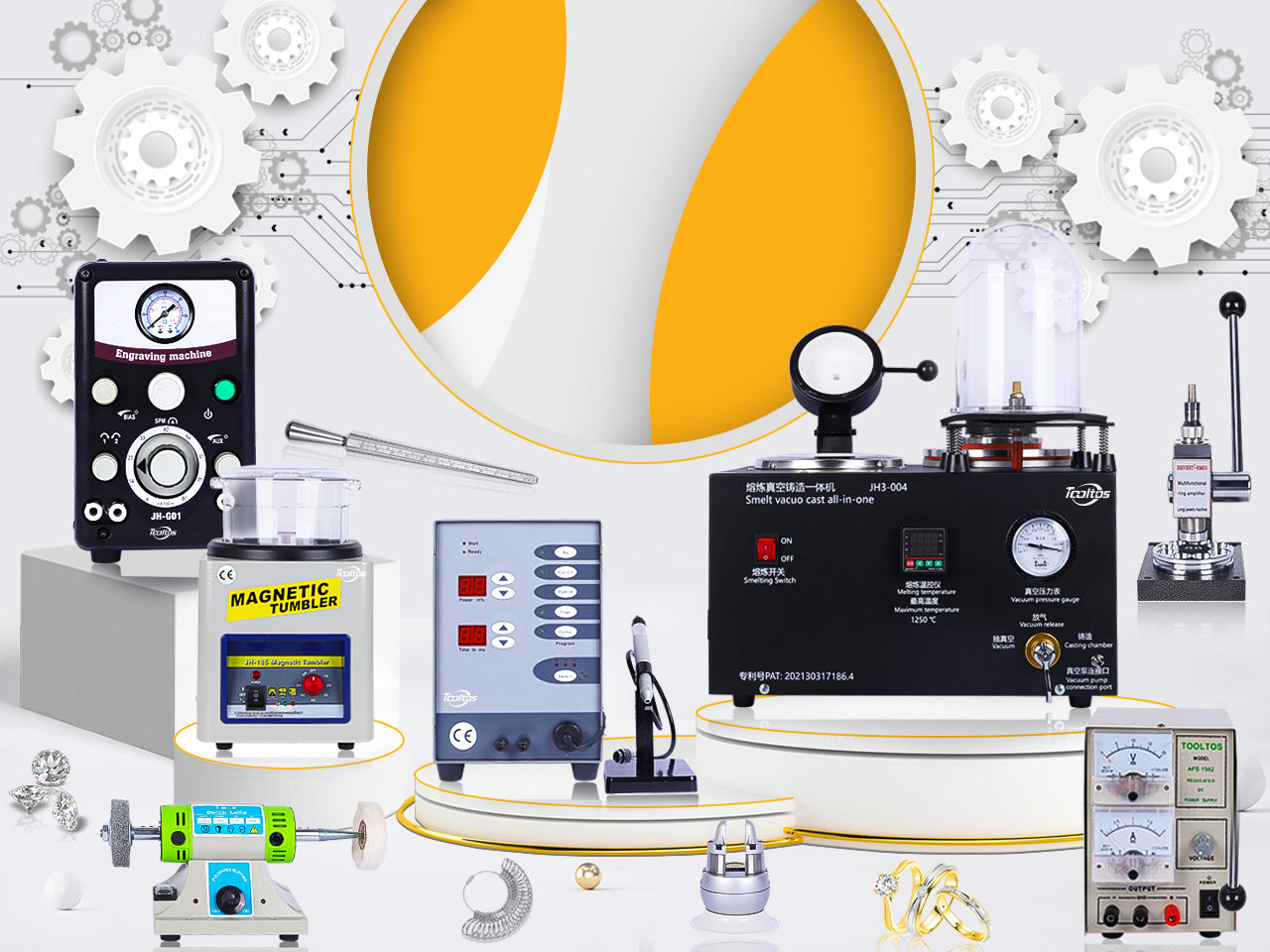
A basic small metalsmith or jewelry workshop setup may include: an electric melting furnace, vacuum casting machine, jewelry pulse spot welder, vertical polishing machine, ultrasonic cleaner, jewelry rolling mill, wax injector, ring stretcher and reducer, bangle size expander, holding tools, and basic hand tools.
Tooltos' product positioning is focused on practical, professional equipment with strong value. Instead of competing only on low prices, Tooltos aims to build complete small-workshop solutions through stable product performance and dependable after-sales support.
View jewelry tool kits and sets
4. The Growth of Lab-Grown Diamonds Is Driving Demand for Stone Setting and Precision Repair Tools
The global lab-grown diamond market continues to grow rapidly. More consumers are buying affordable lab-grown diamond rings, custom gemstone jewelry, and personalized fine jewelry. As a result, local repair shops are seeing increasing demand for prong tightening, stone resetting, ring mounting repair, polishing, and ultrasonic cleaning services.
Frequently searched tool keywords include: stone setting tools, prong repair tools, jewelry microscope, pneumatic engraver, polishing machine, ultrasonic cleaner, jewelry welding machine
Stone setting and micro repair work require jewelry microscopes, pneumatic engraving machines, precision welders, polishing equipment, and cleaning machines for professional repair benches. Through educational content, Tooltos helps jewelry repair shop owners build systematic and efficient workbench tool setups.
View ultrasonic cleaners | View magnifiers and loupes
5. Bangle and Ring Resizing Tools: Long-Term Repeat Demand for Repair Shops
Wide bangles, stacked rings, and irregular open bracelets are among the mainstream jewelry styles for 2026. Ring resizing and bangle expansion remain evergreen repair services for jewelry stores and repair shops.
Popular tools include: bangle size expander, bangle bracelet stretcher, ring stretcher and reducer, ring mandrel, bracelet forming tool, ring bending tool
For these products, it is important to clearly state the usage limits. A bangle size expander is designed only for soft precious metals such as gold, silver, and copper. It should not be used on titanium steel, hollow bangles, stone-set bangles, or plated bracelets that may be easily damaged. Clear product limitations improve professional credibility and help reduce returns and exchanges.
View measuring and sizing tools
6. Matching Equipment by Business Type: A Tooltos Selection Guide
Different business models require different equipment priorities. Buyers should choose tools based on their actual workflow rather than stocking machines blindly.
- For permanent jewelry services: prioritize a pulse spot welder and a basic jewelry repair hand tool kit.
- For lost wax casting: choose a complete setup including an electric melting furnace, vacuum casting machine, investment mixing equipment, and preheating furnace.
- For local jewelry repair shops: focus on polishing and cleaning equipment, stone setting tools, bangle and ring resizing machines, and micro welding equipment.
- For jewelry schools and training centers: prioritize standardized equipment sets that are safe, stable, and easy to operate.
Tooltos organizes product solutions around real production workflows, helping increase order value while reducing the customer's cost and difficulty in selecting the right equipment.
Conclusion: The 2026 Jewelry Tool Trend Is Compact and Professional
The overall direction of the jewelry tool market is clear: buyers need professional equipment that fits small workshops. Customers are no longer looking only for the lowest price. They care more about whether the equipment can be used effectively in real work, including welding, casting, preheating, polishing, stone setting, ring resizing, and daily repair.
Tooltos will continue to focus on five key product lines throughout the year:
- Permanent Jewelry Welders
- Jewelry Casting Equipment
- Small Jewelry Studio Setup Solutions
- Stone Setting and Repair Tools
- Bangle and Ring Resizing Tools
As the jewelry industry continues to move toward precise, small-batch, customized production, equipment stability, ease of use, and after-sales support will become the core competitive advantages of any brand. With application-based products and professional educational content, Tooltos helps small and medium-sized jewelry workshops around the world build standardized and efficient production workflows.
0 comments