

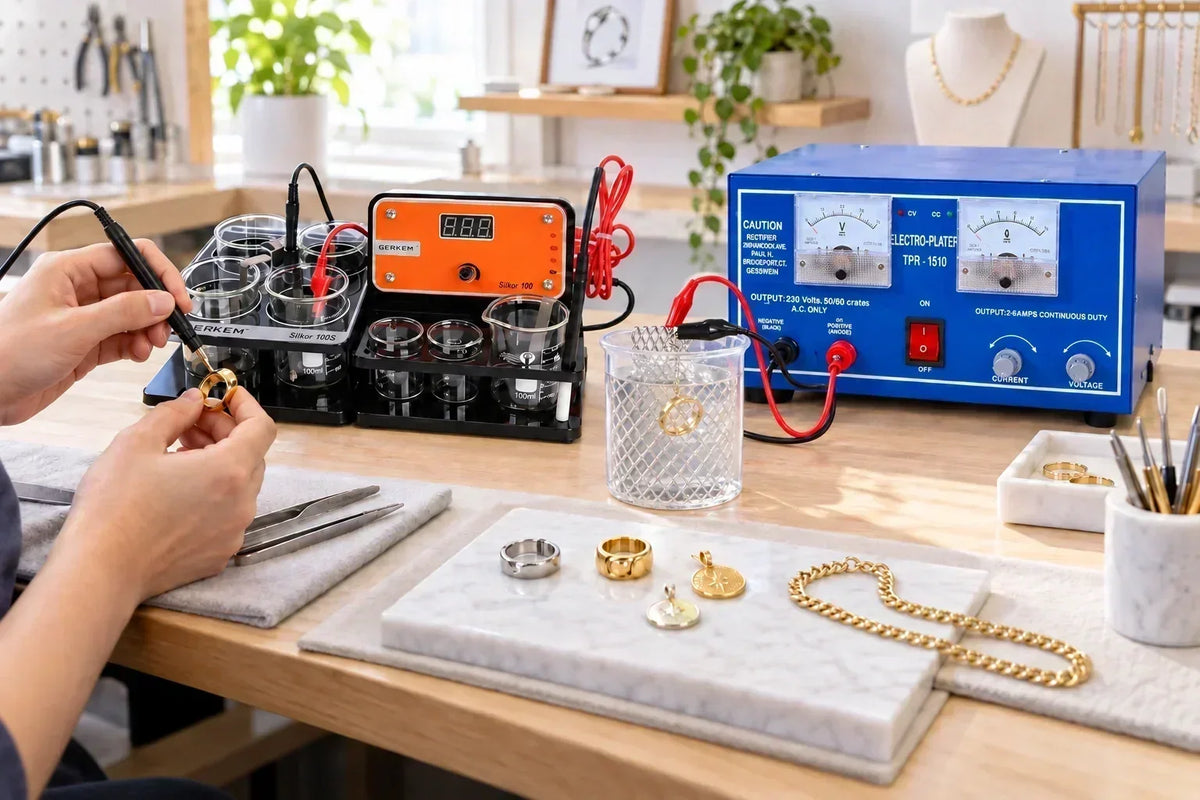
Choosing jewelry plating equipment starts with the job, not the largest current rating. A pen-type system applies solution to a local area; a bench rectifier supplies controlled DC power for a plating bath. They solve different finishing problems, and many small studios need one before they need the other.
Start With Local Repair or Full Coverage
Use a pen-type machine when the task is a worn spot, repair area or selective accent. The applicator lets you work on a limited area without immersing the whole piece. The Tooltos Jewelry Pen-Type Plating Machine Galvanizing Gold Plating Kit has adjustable 0–3A output and a 2–13V range for jewelry-scale localized work.

Choose a tank-plating setup when you need consistent coverage across an entire ring, chain, setting or a repeat batch. It requires a prepared bath, anodes, work holding and a bench process that can be repeated safely.
| Approach | Typical use | Main consideration |
|---|---|---|
| Pen-type plating | Worn spots, repairs, and accents | Direct control over a small area |
| Tank plating | Whole pieces and repeat batches | A prepared bath and repeatable bench process |
| Rectifier-led setup | Controlled power for tank work | The rectifier is one part of the process, not the complete bath |
What a Rectifier Adds
A plating rectifier converts mains power to adjustable DC output. Unlike a pen system, it is the power-control part of a tank process, not a ready-made plating bath. You still need metal-specific solution, suitable anodes, containers and correct connections.

For regular bench-scale tank work, the Tooltos TPR-1510 Plating Rectifier provides adjustable output up to 15V and 10A, with separate digital current and voltage readouts. Its compact 260 × 240 × 150 mm size suits a dedicated bench station. The higher-capacity PM260A reaches 20V and 30A for studios whose work actually demands more current and longer operating sessions.
Compare Control, Not Just Maximum Amps
Current density depends on the surface area of the piece, the bath chemistry and the finish being applied. More available amperage does not automatically create a better surface. A small repair area can need a very different setting from a batch of larger pieces.
For this reason, choose equipment with controls you can read and repeat. A pen machine is practical for localized work because its operator controls placement directly. A dual-display rectifier is useful for tank work because current and voltage can be seen simultaneously while the bath process is monitored.
Plan the Rest of the Station
Neither machine eliminates chemical-process requirements. Plating solutions are sold separately. Prepare a stable, chemical-resistant work surface; use the solution supplier's instructions; provide appropriate ventilation; and wear chemical-resistant gloves and eye protection. Keep electrical equipment, open flames and unrelated bench work away from the plating area.
For tank plating, also plan beakers or tanks, anodes, clips or racks, rinse steps and drying. For pen plating, confirm that the included cups, lines and applicator are appropriate for the solution and repair method you intend to use.
A Simple Buying Decision
Choose a pen-type plating machine if your work is primarily touch-ups, repair spots and selective accents. Choose a 10A rectifier if you are building a controlled tank-plating station for whole-piece or repeat-batch coverage. Move to a 30A rectifier only when the size of your work, bath process and production schedule justify it.
The right choice is not the machine with the biggest number. It is the system that matches your coverage area, process control and safe finishing setup.
Contact and Support
For product guidance, compatibility questions, or order assistance, contact the Tooltos sales support team at sales@tooltos.com.
0 comments