
Inside-ring engraving turns a standard ring into a personal item without changing its visible design. It can be a useful service for wedding bands, anniversary gifts, memorial pieces and repair-shop customers, but only when the engraver, ring style and character requirements fit one another.
Quick answer: Choose a manual inside-ring engraver when your work mainly involves short names, dates, initials and numbers on compatible non-ferrous rings. Before buying, confirm the available character set, character height, usable space inside the band and the operator's ability to control pressure consistently.
Who Is an Inside Ring Engraver For?
A dedicated inside-ring engraver can suit jewelry studios, repair benches, wedding-band retailers and small personalization businesses that receive repeat requests for discreet inscriptions. It gives the operator a purpose-built way to position a ring and apply compact characters to the inner surface.
It is not automatically the right choice for every personalization service. If most customer requests involve logos, handwriting, decorative graphics, unusual alphabets or automated production, another engraving method may offer greater flexibility.
Start With the Message You Need to Offer
An inside-ring engraver is best for repeatable, compact text such as names, dates, initials and short numbers. It is not a substitute for a laser system or a freehand engraving setup when the job requires custom scripts, logos, graphics or very small characters.
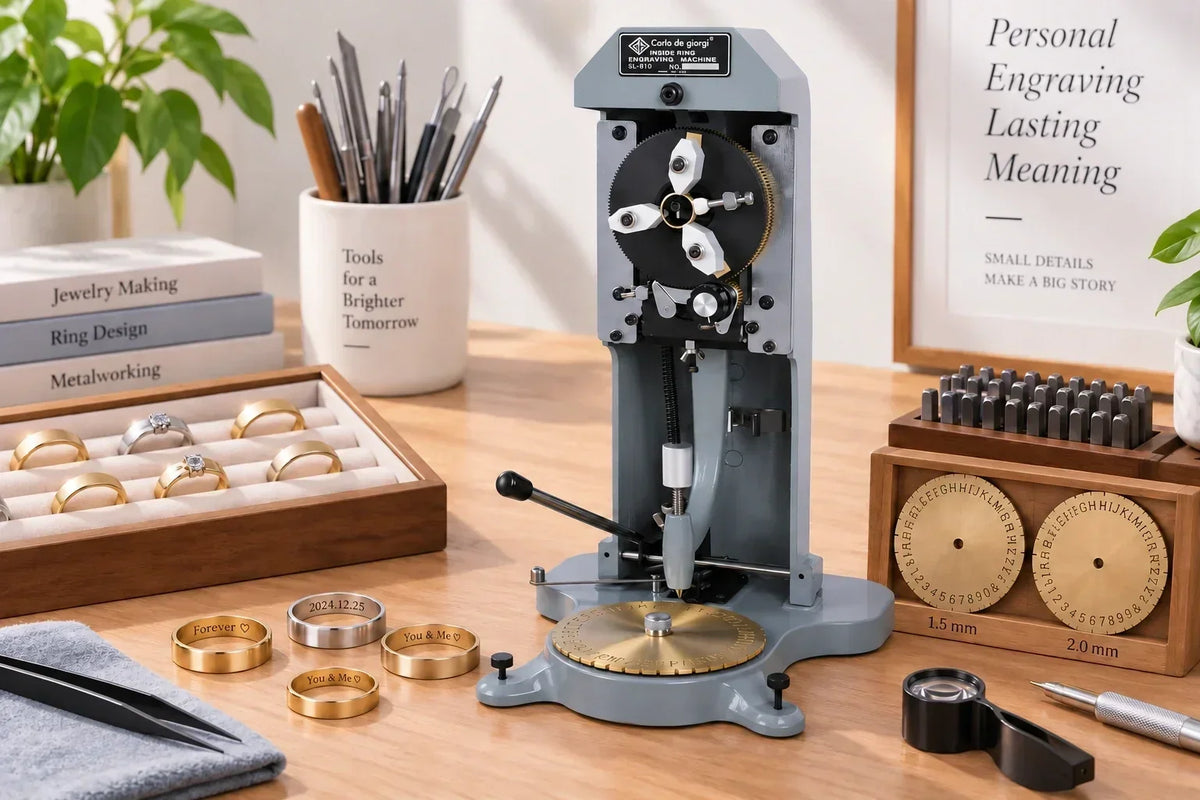
The Tooltos Inside Ring Engraver uses a dual-sided letter-block plate with 1.5 mm and 2.0 mm character heights. It supports English letters and Arabic numerals. Confirm that this character set and scale match the inscriptions your customers request most often before buying.
Define the service before choosing the machine
- List the ten inscriptions customers request most often.
- Record the typical band widths and interior profiles you handle.
- Decide whether you will offer letters and numbers only.
- Set a practical maximum message length for each ring style.
Choose Character Size by Band Width
Legibility depends on proportion, not simply on the deepest possible mark. The smaller 1.5 mm characters suit narrow bands; 2.0 mm characters are better suited to wider shanks where the inscription needs more visual presence.
Measure the usable interior surface, not the ring's outside width. A curved interior, comfort-fit profile, existing engraving or narrow shoulders may reduce the practical writing area. Set a clear studio policy for message length before accepting a job.
| Factor | What to Check | Why It Matters |
|---|---|---|
| Character height | Compare 1.5 mm and 2.0 mm options with the usable inner surface. | Oversized text can feel crowded on a narrow band. |
| Interior profile | Check flat, curved and comfort-fit surfaces individually. | The profile affects contact, alignment and usable space. |
| Message length | Count every letter, number and space before engraving. | Planning reduces uneven spacing and incomplete layouts. |
| Existing details | Look for hallmarks, previous engraving and nearby settings. | These details can reduce the safe engraving area. |
Check Ring and Metal Compatibility
This type of manual diamond-nib tool is designed for the inside surface of suitable gold, silver, copper, platinum and other non-ferrous rings. It is not intended for steel or titanium rings. Its 360-degree rotating jaw can accommodate narrow, wide and set rings, but secure holding does not remove the need to protect stones and inspect clearances.
Do not treat every ring as a candidate. Very thin shanks, unusual interior profiles, fragile vintage pieces and rings whose settings could contact the tool need careful evaluation before marking.
Accept, test or decline
- Accept: the metal, geometry, message and available character sizes are clearly compatible.
- Test first: the ring has an unfamiliar alloy, curved interior or limited clearance, but a safe assessment is possible.
- Decline or use another method: the ring is steel or titanium, structurally fragile, or requires artwork outside the fixed character set.
Understand What Manual Control Means
The Tooltos system is fully manual and does not require electricity. The operator guides a diamond nib along the letter block, controlling pressure and depth. This makes it compact and straightforward for a bench, but quality still depends on practice and consistent handling.
Manual engraving is appropriate when a studio values direct control and a repeatable fixed character set. It is less suitable when personalization demand is high-volume, automated or heavily design-led.
Important: A character guide improves repeatability, but it does not replace operator practice. Pressure, alignment, spacing and ring security should be tested on compatible scrap material before working on a customer's ring.
Build a Repeatable Bench Process
- Inspect the ring. Identify the metal, interior profile, hallmarks, stones and possible contact points.
- Confirm the message. Check spelling, capitalization, numbers, spacing and character availability with the customer.
- Plan the layout. Count the characters and identify the center point before making the first mark.
- Prepare the surface. Clean the interior so oil and polishing residue do not interfere with the nib.
- Secure and test. Level the machine, select the plate, hold the ring safely and practise unfamiliar layouts on compatible scrap material.
- Engrave with control. Use light, even pressure and inspect progress before removing the ring.
- Finish the job. Clean the interior, inspect the inscription and photograph the completed work if required by your studio process.
Customer approval matters
Engraving is difficult to reverse cleanly. A written job record showing the exact message, capitalization and approved layout can help prevent avoidable errors. The operator should pause whenever the ring condition or requested inscription differs from the approved plan.
Common Buying and Operating Mistakes
- Buying before checking the character set: fixed letter blocks cannot reproduce every font, symbol or language.
- Measuring only the outside of the band: the usable inner surface may be much smaller.
- Accepting every metal: steel and titanium require a different approach from the compatible non-ferrous rings described here.
- Skipping a practice piece: unfamiliar spacing or pressure can lead to permanent errors.
- Ignoring stones and settings: secure clamping does not guarantee safe clearance around delicate components.
A Quick Buying Check
Choose an inside-ring engraver if your studio regularly handles personalized rings and can answer yes to these questions:
- Are English letters, Arabic numerals and 1.5 mm or 2.0 mm characters appropriate for your typical requests?
- Do you mainly work with compatible non-ferrous rings?
- Can you assess ring geometry and stone clearance before accepting a job?
- Can an operator practice and use a controlled manual process?
- Will a dedicated manual station match your expected order volume?
For this workflow, a dedicated interior engraver creates a practical service station. Choose another engraving method when the job calls for external decoration, custom artwork, steel or titanium, or automated high-volume marking.
Frequently Asked Questions
Can an inside ring engraver create logos or handwriting?
A fixed character-block system is intended for its supplied letters and numbers. Logos, handwriting and custom graphics generally require a more flexible engraving method.
Which character size should I choose?
Choose according to the usable interior surface and desired visual balance. A 1.5 mm character is better suited to narrower spaces, while a 2.0 mm character provides more presence when the band allows it.
Can it engrave steel or titanium rings?
No. The manual diamond-nib system discussed here is not intended for steel or titanium rings.
Does a manual engraver require electricity?
The Tooltos model described in this guide is manually operated and does not require electricity.
Should I practise before engraving a customer ring?
Yes. Practise the layout, spacing and pressure on compatible scrap material, especially when the message or ring profile is unfamiliar.
Support
Need help choosing an inside ring engraver for your workshop? Contact Tooltos at sales@tooltos.com.
0 comments