

Cast in place jewelry has an irresistible moment: a stone is seated in wax, the flask is invested, and the finished piece seems one casting away. When it works, the stone appears to have grown out of the metal instead of being added afterward.
That same moment is where the risk begins. Once the flask is prepared, the stone is no longer simply part of the design. It must endure every decision made around it.
The key decision comes before casting: confirm that the exact stone, its treatment history, and the intended process are compatible. A casting machine cannot establish that compatibility for you.
The Stone Enters Before the Metal
It is tempting to ask, “Will my casting machine handle this?” The more important question is whether this exact stone belongs in the flask. Heat, temperature change, investment pressure, molten metal contact, and cleaning affect gems differently.
Hardness alone is not an answer. A stone that wears well in a ring may still be a poor candidate for direct casting. Its identity, treatment history, supplier guidance, and process limits all matter. If any are uncertain, choose a design that allows the stone to be set after casting.
Wax Gives the Stone Its Future Seat
In conventional setting, metal can be adjusted around a stone after casting. In cast in place work, the wax model makes those decisions in advance: how deeply the stone sits, where metal supports it, and whether vulnerable edges have enough protection.
That is why a wax model that merely looks right is not enough. The stone should be held consistently before investing, with its orientation planned and adequate metal around the seat. If the stone moves, cracks, or the casting misfills, can the area be corrected without sacrificing the piece?

A Sprue Is a Route for Metal Not a Shortcut
The sprue layout determines how metal reaches detailed parts of the mold. It should feed the piece without making the stone or setting the first obstacle in the path. A convenient position may be wrong if it sends the strongest flow toward a delicate zone.
There is no standard placement for every ring or pendant. Test one geometry with the same stone type, wax seat, investment, and parameters. A clean result is evidence for that combination, not every future design.
Burnout Still Matters With the Stone in Place
Direct casting does not remove the usual disciplines of lost wax work. Investment mixing, vacuum degassing, curing, burnout, and flask preheat shape the mold cavity. Follow the investment manufacturer’s instructions and confirm that the required cycle is compatible with the stone supplier’s guidance. Do not apply a generic schedule or assume that a lower temperature will produce an adequately prepared mold.
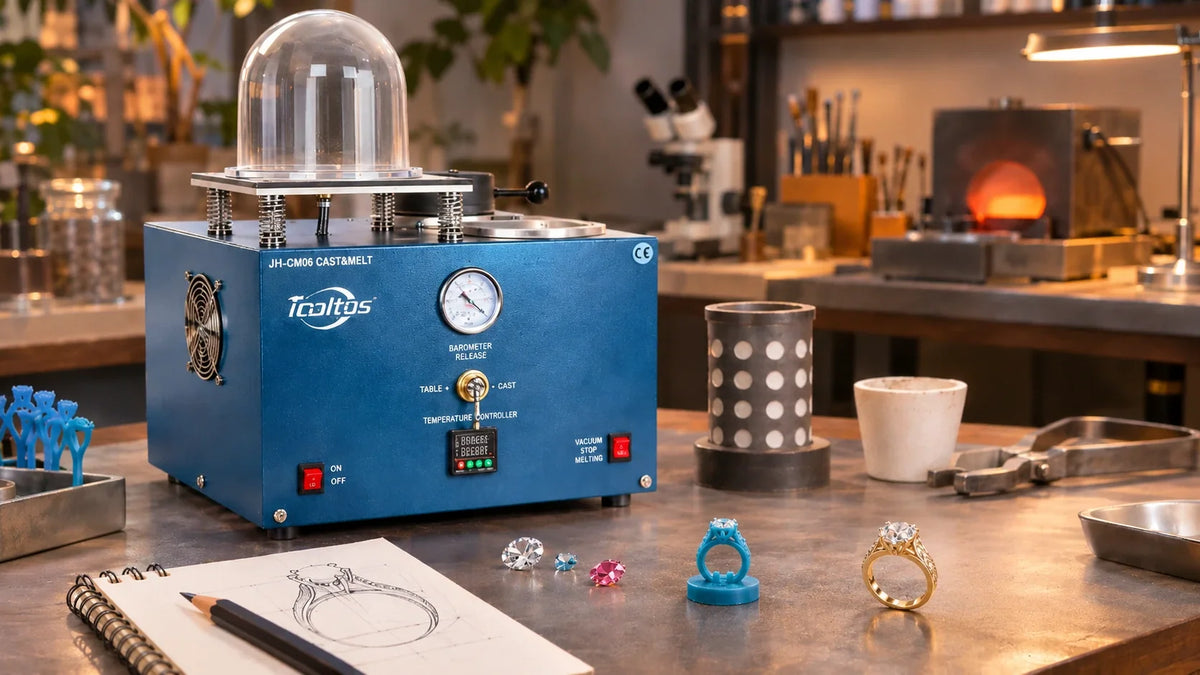
The Tooltos JH-CM06 vacuum casting and melting machine combines melting, vacuum-assisted casting, and investment degassing for small studios. Its pump does not replace a burnout furnace or validate a stone choice. It is specified for suitable metals below 1100°C, not platinum, stainless steel, or titanium. This metal temperature limit is not a safe temperature rating for a gemstone.
A Good Test Records More Than the Final Appearance
The first successful cast can mislead if nothing was recorded. Keep the variables visible so the next trial can be compared with the first.
- Stone: identity, treatment history, supplier guidance, and placement.
- Model and mold: wax dimensions, seat geometry, sprue layout, investment, and flask.
- Process: burnout cycle, metal, casting settings, and cooling and cleaning methods.
- Result: stone movement, visible cracks, incomplete fill, exposed edges, or color change after cooling.
Follow material-specific cooling and cleaning guidance rather than assuming a routine quench or cleaning method is suitable for a cast-in stone. A visually clean result alone does not establish that the stone is undamaged.
If a cast fails, work backward instead of blaming the last machine involved. The answer may lie in the stone, wax seat, sprue path, investment, or burnout. Reliable work comes from a documented process that produces repeatable results.
Use the Technique When It Earns Its Place
Cast in place setting is not automatically faster. Use it when stone and design have been tested together under a documented process, and when post-casting setting cannot achieve the form as cleanly. For one-off gems, delicate material, or an untested design, conventional setting leaves more room for adjustment without exposing the stone to the casting cycle.
For machines that support different stages of a small casting workflow, explore Tooltos jewelry vacuum casting machines. Choose the machine after the material and process are clear, not before.
Contact Tooltos
Have questions about Tooltos casting equipment or choosing a machine for your workshop? Contact our team at sales@tooltos.com.
0 comments