

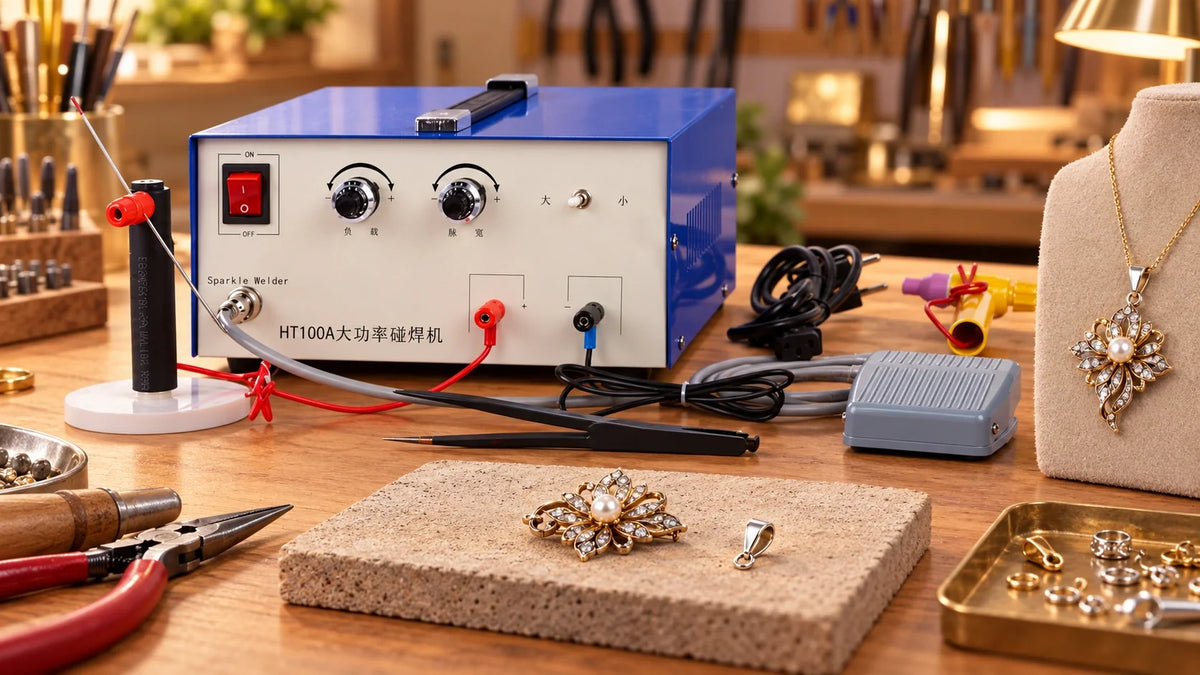
A brooch can look promising as a pendant until it rotates on the chain and exposes its back. The useful question is whether it has a structurally sound, visually balanced point for a fixed bail, and whether the material can safely accept heat. A poorly placed attachment can damage the piece or make it hang even worse.
Start with the Direction of the Finished Pendant
Hold the brooch in its intended upright position and identify its visual centerline. An asymmetrical motif may need the attachment point slightly offset to balance its weight. Test the direction with a temporary, non-damaging support before committing to a permanent join.
Check the back as carefully as the front. The bail needs a flat, substantial attachment area that will not flex under the pendant's weight. Avoid mounting to a thin pin mechanism, a hollow decorative element, a stressed seam, or a damaged area. If the original pin and catch are retained, make sure the new bail does not interfere with them or create an uncomfortable projection.
Three Checks Before You Commit
- Orientation: Test the intended hanging point with a temporary support. Does the front stay upright rather than tipping or turning?
- Structure: Inspect the proposed attachment area. Is it substantial, undamaged and free from flexing?
- Wearability: Check the chain path and the retained pin hardware. Will either catch, rub or project uncomfortably?
Decide Whether Heat Is Appropriate
Do not heat an unidentified, plated, costume, antique, or potentially valuable brooch just to convert it. Plating can discolor, adhesives can fail, and some stones, enamels, coatings, or previous repairs can be damaged by local heat. Confirm the base metal, the bail metal, existing joins, and every nearby material first.
A removable or mechanical finding is the safer route when material identity is uncertain or preservation matters. A permanent weld or fusion join is a workshop operation for pieces with confirmed compatible metals and a design that can tolerate the process.
A small weld is still a heat-based intervention. Localized heat does not remove the risks posed by plating, adhesives, fragile settings or unknown previous repairs.
Match the Bail to the Chain and the Weight
The bail opening must clear the selected chain or cord, but an oversized bail can allow excessive rotation. Consider the pendant's total weight, the chain profile, and the direction of pull. A narrow bail still needs enough metal at the connection to remain durable in normal wear.
Before joining, position the bail against the back and check the piece from the front. Confirm that the bail stays hidden where intended, that the pendant hangs upright, and that the chain path does not rub on sharp edges. This simple dry fit prevents a permanent joint in the wrong place.
Dry-fit checklist: Chain clears the opening · Pendant faces forward · Bail sits where intended · No sharp contact points · Original hardware remains unobstructed
When Controlled Pulse Welding May Be Appropriate
For a studio that regularly repairs confirmed compatible jewelry metals, the Tooltos 100A Pulse Jewelry Spot Welder For Gold, Silver And Platinum is an option to evaluate for a small attachment point. It uses high-frequency pulse discharge and has a stated 0.5–2.0 mm (approximately 0.020–0.079 in) welding range for gold, silver, platinum, palladium, and stainless steel. A foot switch and handheld welding torch are included, allowing the operator to position the workpiece before triggering a brief weld.

Those specifications do not make every conversion suitable for pulse welding, nor do they guarantee a durable bail attachment. The work still requires compatible metals, a secure fixture, appropriate welding eye protection, and practice on matching scrap. Do not use a localized weld as a shortcut around uncertain construction, plating, or heat-sensitive materials. Follow the machine instructions and press and release the foot switch rather than holding it down continuously.
Keep the Conversion Reversible When the Piece Calls for It
Some brooches are better preserved as brooches. If the goal is occasional wear as a pendant, a reversible adapter may be more appropriate than a permanent bail. If the piece has collectible value, fragile settings, unknown construction, or a complex back, consult a qualified jeweler before changing it.
Which Route Fits the Piece?
| Situation | Route to Consider | Key Check |
|---|---|---|
| Occasional pendant wear while retaining brooch use | Reversible adapter | Secure fit, correct orientation and no damage to the existing hardware |
| Confirmed compatible metals and a sound attachment area | Professional assessment for a fixed bail | Heat tolerance, joint design, balance and durability |
| Unknown materials, delicate construction or collectible value | Pause permanent modification | Qualified jeweler's assessment before selecting any conversion method |
Choose a permanent fixed bail only when it improves both orientation and wearability without compromising the original piece. For other joining and repair applications, explore Tooltos jewelry welding machines and spot welders after confirming the material and the type of joint required.
Contact Tooltos
For product questions, equipment compatibility assistance, or order support, contact the Tooltos team at sales@tooltos.com. When asking about equipment compatibility, please include the machine model, materials and intended task so our team can better understand your needs.
0 comments