

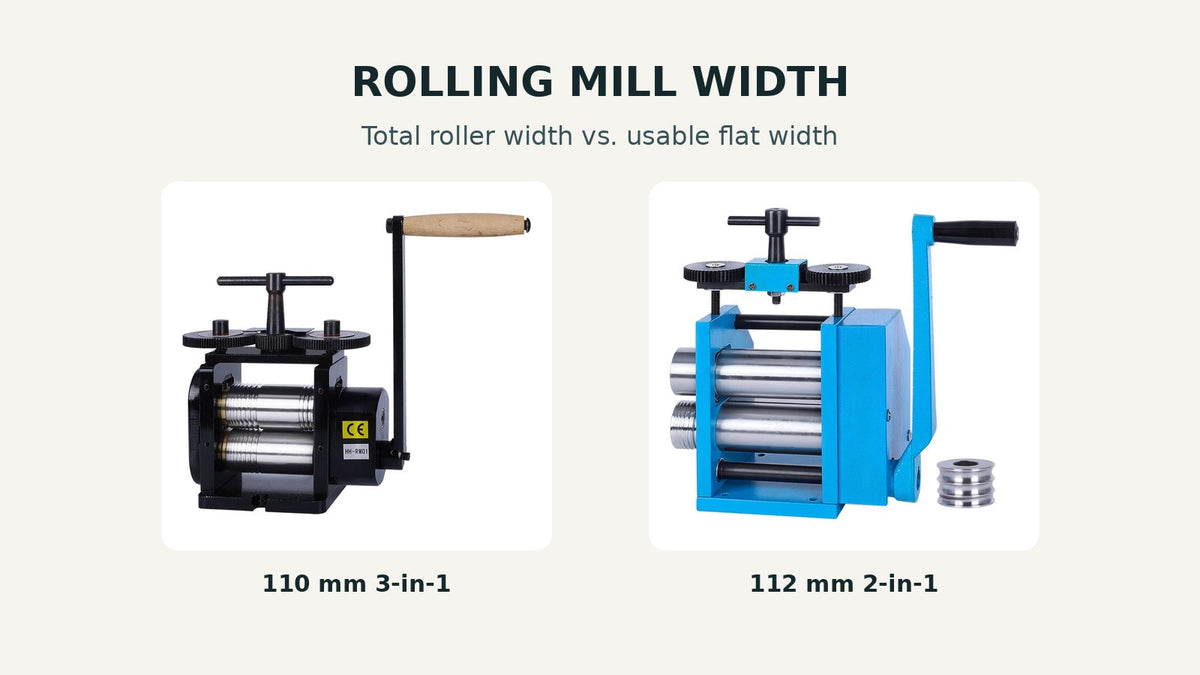
A 110 mm rolling mill can have only 53 mm of usable flat width. On the Tooltos 110 mm 3-in-1, the 110 mm measurement includes the grooved sections. A 25 mm ring-band strip fits on the smooth section, while a 60 mm cuff blank fed with its full width across the rollers needs a wider smooth face.
Measure the width that goes between the rollers
- Choose the feed direction. Decide which edge enters the mill first. That edge determines the width across the rollers on a rectangular blank.
- Measure the widest point across the feed direction. For a cuff, measure the blank before bending. For roll printing, measure the widest part of the full setup, including any plate or backing approved for your mill.
- Compare that measurement with the uninterrupted smooth section. Allow room to position the workpiece and check the starting thickness against the mill’s specifications.
Three measurements to check before you buy
- Total roller width
- The width across the roller face. On a combination mill, this can include both the smooth section and the wire grooves.
- Usable flat width
- The continuous smooth section that supports the whole workpiece. Use this measurement for sheet, strip, and any texture setup the manufacturer approves.
- Maximum roller opening
- The largest gap between the rollers. It tells you what can fit at the entry, while the alloy, stock dimensions and manufacturer’s limits determine what you can safely reduce in a pass.

What fits on a 53 mm flat section?
- 25 mm strip. Fits comfortably, with 28 mm of total clearance across the smooth face.
- 52 mm blank. Fits on paper, but leaves just 1 mm of total clearance. Choose a wider flat face if you regularly work this close to the edge.
- 60 mm sheet. Exceeds the flat section by 7 mm when the 60 mm edge enters first. A 60 × 30 mm rectangle can fit if the 30 mm edge enters first and that orientation works for the piece.
Turning a blank changes the direction of elongation and can change pattern alignment. For roll printing, check both the width and the combined thickness of the complete setup, then test on scrap.
Two Tooltos mills with similar roller widths
| Measurement | 110 mm 3-in-1 | 112 mm 2-in-1 |
|---|---|---|
| Flat width | 53 mm | Up to 112 mm |
| Maximum opening | 4 mm | 7 mm |
| Profiles | Flat, square and half-round | Flat and half-round with a separate grooved roller |
The Tooltos 110 mm 3-in-1 fits a bench workflow that moves between narrow flat stock, square wire and half-round profiles. If you mostly work on wider flat blanks and occasionally form half-round stock, check the Tooltos 112 mm 2-in-1, which comes with a separate semicircular groove roller. Check groove dimensions against your projects as well as the flat width.

Check the fit with a scrap piece
- Securely bolt the mill to a sturdy bench or stand as directed by its manual. Keep fingers, loose clothing, jewelry and hair away from the rollers and gears.
- With the rollers stopped, confirm that the width and starting thickness of clean, dry scrap fit the smooth section and the machine’s specifications. Use scrap of the same alloy as your project.
- Start with a light pass and measure the result. Make gradual reductions and follow the manual and alloy-specific guidance on annealing. If the handle binds or resistance rises sharply, stop and check the gap, stock and setup before continuing.
Frequently asked questions
Can I roll a wider sheet in two overlapping passes?
For a uniform flat finish, use a smooth section that supports the entire width. Overlapping passes across a groove boundary can leave lines or uneven thickness.
Does a 7 mm opening mean I can remove 7 mm in one pass?
The 7 mm specification describes the entry gap. A single pass should make a gradual reduction appropriate to the machine, stock width and alloy.
Do I need a mill if I buy sheet and wire to size?
For occasional projects in standard dimensions, buying stock to size can keep your bench setup simple. A mill becomes more useful if you repeatedly need custom thicknesses or profiles. Start with the widest blank you expect to make regularly, then compare the manual rolling mills that fit that work.
0 comments