

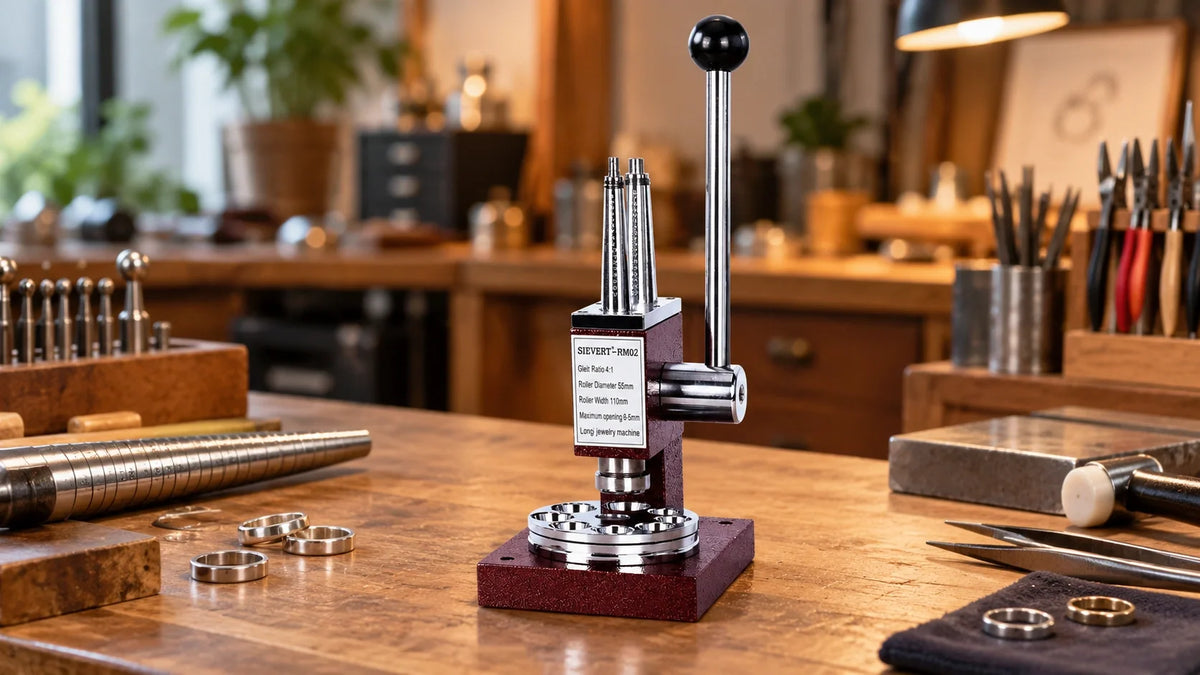
A ring stretcher and reducer can make an in-house repair workflow more capable, but it is not the answer to every sizing request. The machine applies controlled force to a suitable band. It cannot correct a cracked shank, protect a fragile setting, or make an unsuitable material safe to resize. The first decision is always whether the ring belongs in the machine at all.
The short answer
Consider a ring stretcher and reducer for suitable plain, non-ferrous metal bands after inspection. If the ring has stones, structural damage, uncertain metal, or construction you cannot assess, specialist evaluation comes first.
Start with the ring, not the requested size
Inspect the band before choosing an expanding or reducing operation. Plain metal bands are the clearest candidates because their structure is easier to assess and their profile is less likely to interfere with the tool. Look for visible damage, unusually thin areas, prior repairs, solder joints, hollow construction, and decorative details that may react poorly to compression or expansion.
Stone-set rings require particular caution. Changing the band can place stress on settings and stones even when the shank appears straightforward. Steel and titanium rings are not suitable for the non-ferrous-metal ring stretcher discussed here and require specialist evaluation. When the risk is unclear, set the ring aside for professional evaluation instead of treating the first pass as a test.
Potential candidates
- Plain bands with an assessable structure
- Suitable non-ferrous jewelry metals
- Work within the tool’s capacity and the ring’s assessed limits
Pause for specialist assessment
- Stone settings or fragile decorative details
- Cracks, thin areas, hollow construction, or uncertain repairs
- Unknown metal, steel, or titanium
What a two-in-one ring stretcher and reducer adds to a repair bench
The Tooltos US 1-33 2-in-1 Ring Stretcher Expander and Reducer combines expansion and reduction in one bench-mountable machine. Its six-segment mandrel covers US sizes 1 through 33, while its eight reduction dies range from 15 to 24 mm in diameter. Four pre-drilled mounting holes help secure the 9.3 kg (20.5 lb) machine to the bench for controlled operation. The machine’s size range describes its capacity, not the amount by which any individual ring can safely be resized.
At a glance for bench planning
Expanding range
US sizes 1–33
Six-segment mandrel
Reduction dies
Eight dies
15–24 mm diameter range
Bench setup
9.3 kg (20.5 lb)
Four mounting holes
Capacity is not a safe resizing allowance for every ring. Assess the individual band before choosing an operation.
That range is valuable for a repair shop that handles different band sizes and needs both functions regularly. It is less compelling for occasional hobby use, for a shop that works mainly in another size standard, or for repairs that routinely involve set stones and complex construction.
Use gradual changes and inspect between passes
For a suitable plain band, work toward the target in small increments rather than attempting the full change at once. Stop after each pass to check the roundness of the shank, the surface condition, and any change in the ring’s proportions. If the metal shows cracking, distortion, or unusual resistance, do not force the next step.
Bench mounting also matters. A heavy resizing machine needs a stable working surface and enough room to operate the lever without twisting the ring or the tool. Confirm the sizing standard before beginning. If the ring was measured in another system, verify the corresponding US size with appropriate measuring tools rather than treating the size numbers as interchangeable.
A checkpoint sequence for suitable bands
- Assess. Check the metal, construction, surface condition, and repair history.
- Prepare. Secure the machine, check lever clearance, and confirm the size standard.
- Adjust gradually. Make small changes rather than forcing the target size in one pass.
- Inspect again. Check size, roundness, and surface condition before considering another pass.
Stop, do not push through: Cracking, distortion, or unusual resistance is a reason to stop and reassess, not to apply more force.
Decide when the job should leave the bench
Send the work to a qualified jeweler or specialist when the ring has stones, a fragile or sentimental design, uncertain metal, visible structural damage, or a repair history you cannot assess. These are not failures of the machine. They are boundaries that protect the piece and the customer relationship.
For frequent work on suitable plain, non-ferrous metal bands, choose a resizing machine by the size standard, expanding range, reduction-die capacity, bench space, and repair volume you actually handle.
Choose the machine to suit the work
Start with the rings you actually repair, then match the sizing standard, capacity, and bench setup. A wider range is useful only when the work calls for it.
Contact Tooltos
Have questions about choosing a ring stretcher and reducer or need product support? Contact the Tooltos team at sales@tooltos.com.
0 commentaire