

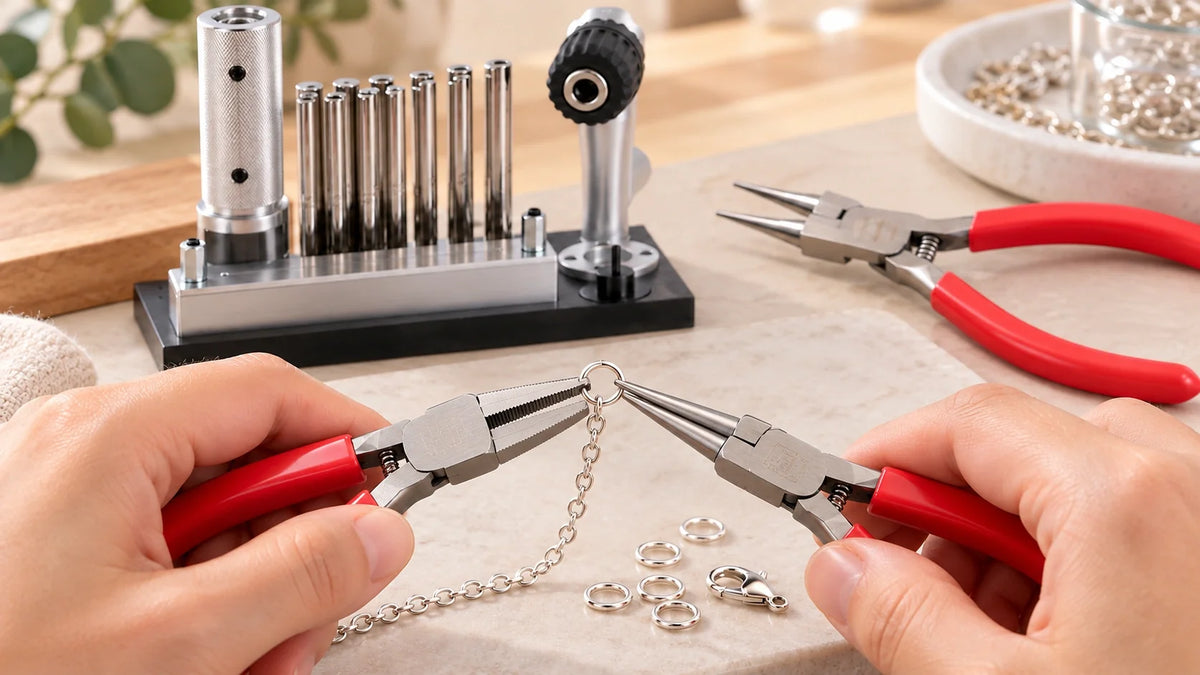
A jump ring may be a small part of a necklace, but it is often the part that determines whether a clasp, pendant, or charm stays attached. The key is to open the ring with a sideways twist, then return the cut ends to the same plane. Pulling the ring apart changes its shape and makes a visible gap more likely.
The technique at a glance
Twist sideways to open. Add every component. Twist back to close. Check that the ends meet flush.
1. Use two pliers and twist instead of pulling
Opening the ring
Hold one side of the jump ring with each pair of pliers. Keep the cut ends facing upward where you can see them. Move one hand slightly forward and the other slightly back to create a sideways opening. Do not pull the ends directly away from one another.
Closing the ring
The same motion closes the ring. Twist the ends back toward one another until they meet. Use a small side-to-side adjustment to align the cut ends, rather than flattening the ring with excessive pressure. The aim is a clean join with no obvious gap and no bent oval shape.
Choosing your gripping pliers
For routine assembly, Tooltos Jewelry Pliers for Jewelry Making are available in flat, round, and pointed nose styles. Flat or pointed nose pliers are the useful pair for gripping and closing jump rings; choose two pliers that give you a secure hold without blocking your view of the join. Keep the jaws clean, and protect soft finished wire from marks when necessary.
2. Add the component before closing the ring
Open the ring only far enough to pass the chain end, clasp loop, pendant bail, or charm through it. Confirm that every intended component is inside the ring before closing it. This quick check prevents the common mistake of closing the ring neatly and then finding that a chain or charm was left out.
When joining a clasp to fine chain, support the chain close to its end rather than letting its links hang and twist. When adding a pendant, check its bail direction before making the final closure. A correctly closed jump ring can still leave a pendant facing the wrong way.
Before the final twist: Check both the components inside the ring and the direction of the pendant bail.
3. Check the connection before calling it finished
After closing, view the join from the front and side. The ends should sit flush and the ring should remain round. Run a fingernail gently across the join: if it catches, realign the ends before wearing the piece. Then pull the connected components lightly in opposite directions. This is a check for seating, not a force test.
Final closure checklist
- The cut ends meet flush, with no obvious gap.
- The ring remains round rather than bent into an oval.
- A fingernail passes gently over the join without catching.
- The connected components stay seated during a light pull.
If the ring keeps opening
If the ring repeatedly springs open, the issue may be the wire hardness, ring thickness, or the type of connection. Replace a distorted ring rather than reopening and reclosing the same piece many times. For a necklace that receives frequent pulling, use a ring and wire choice appropriate to the finished design.
When you need to make your own jump rings
For occasional repairs or a few custom links, pre-made jump rings and two pliers are usually enough. If you need repeatable sizes for chainmaille, bracelets, or a series of matching connectors, the Tooltos Stainless Steel Manual Jump Ring Maker creates coils on mandrels from 2.5 to 12mm. Cut the coil into rings with a suitable method, then use the same sideways-twist technique for assembly.
Choose tools by the task
Use two gripping pliers for opening and closing rings during normal necklace assembly. Choose a mandrel-based jump ring maker when consistent custom sizes are part of regular production. For cutters, pliers, files, and other bench essentials, review the Tooltos jewelry hand tools collection and choose each tool for the material and task.
Contact Tooltos
Have questions about choosing jewelry pliers, jump ring tools, or tools for your next project? Contact us at sales@tooltos.com.

0 commentaire