

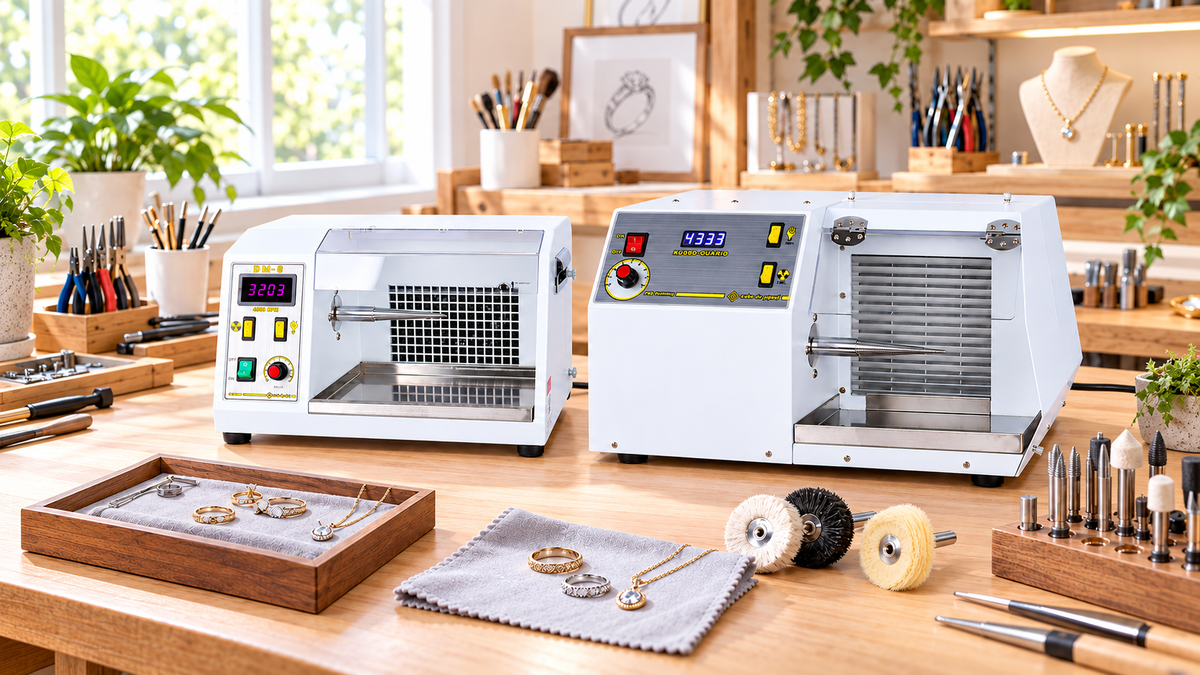
A bench polisher is more than a motor and a buffing wheel. In a working jewelry studio, the choice affects dust handling, bench space, visibility, wheel selection and how consistently an operator can move between finishing steps. The useful question is not which model has the largest number, but which one fits the work your bench performs repeatedly.
Start With the Workload
The Tooltos DM-8 Bench Jewelry Polishing Machine is the lighter option at 15 kg, with a 550W motor and variable 0–4200 RPM speed control. It is a practical fit for a compact studio or repair bench that needs a dedicated dry-polishing station without committing to a heavier machine.
The Tooltos K3600 Bench Polishing Machine uses a 750W motor and reaches 0–4300 RPM. At approximately 20 kg, it is the stronger choice when a studio expects more demanding or longer finishing sessions and has a stable permanent bench position.
Variable Speed Matters More Than One Maximum Setting
Both models use eight-position speed control with a digital RPM display. That makes it easier to set a deliberate speed for the wheel, compound and material being used instead of treating every job as a maximum-speed job.
Start lower for a new material or finishing pass, then increase only when the wheel, compound and workholding remain controlled. Use the wheel and compound supplier guidance for the material; speed alone does not determine surface quality.
Compare the Bench Footprint and Handling
The DM-8 measures 435 × 320 × 275 mm. Its smaller size and 15 kg weight suit a bench where equipment may need to be repositioned or where the polishing station shares space with repair work.
The K3600 is approximately 510 × 380 × 280 mm and 20 kg. Its larger footprint and higher power make more sense when the finishing area is fixed and the bench can support the machine, accessories and normal operator clearance.
Neither choice should be made from dimensions alone. Leave room for wheel changes, compound storage, a material tray, safe hand position and cleaning access.
Dust Collection and Visibility Are Part of the System
Both machines have integrated dust collection and a transparent acrylic shield with illumination. The DM-8 uses a removable collection bag; the K3600 uses built-in suction. These systems help keep generated debris contained at the bench, but they do not replace routine cleaning, appropriate PPE or the studio's wider ventilation plan.
Keep the shield in position during operation, empty or service collection components as instructed and prevent loose jewelry, hair and clothing from entering the wheel area.
Wheel Capacity and Process Limits
Both machines use tapered spindles for polishing wheels and brushes up to 7 inches. This makes them suitable for dry finishing tasks with compatible wheels and compounds on jewelry, selected metals and other listed materials.
They are not wet-polishing machines. Do not introduce water or wet processes into an integrated dust-collection system. They are also not a substitute for industrial equipment when production volume, wheel size or material demands exceed a bench-scale workflow.
A Simple Decision
Choose the DM-8 when a compact, variable-speed, dust-collecting dry-polishing station is the priority and bench space is limited. Choose the K3600 when you need the higher 750W power level for a fixed finishing station and more demanding routine work.
In either case, budget for compatible wheels, compounds, cleaning procedures and safe work practices. A well-matched polishing station is a controlled finishing step, not just a faster wheel.
0 commentaire