

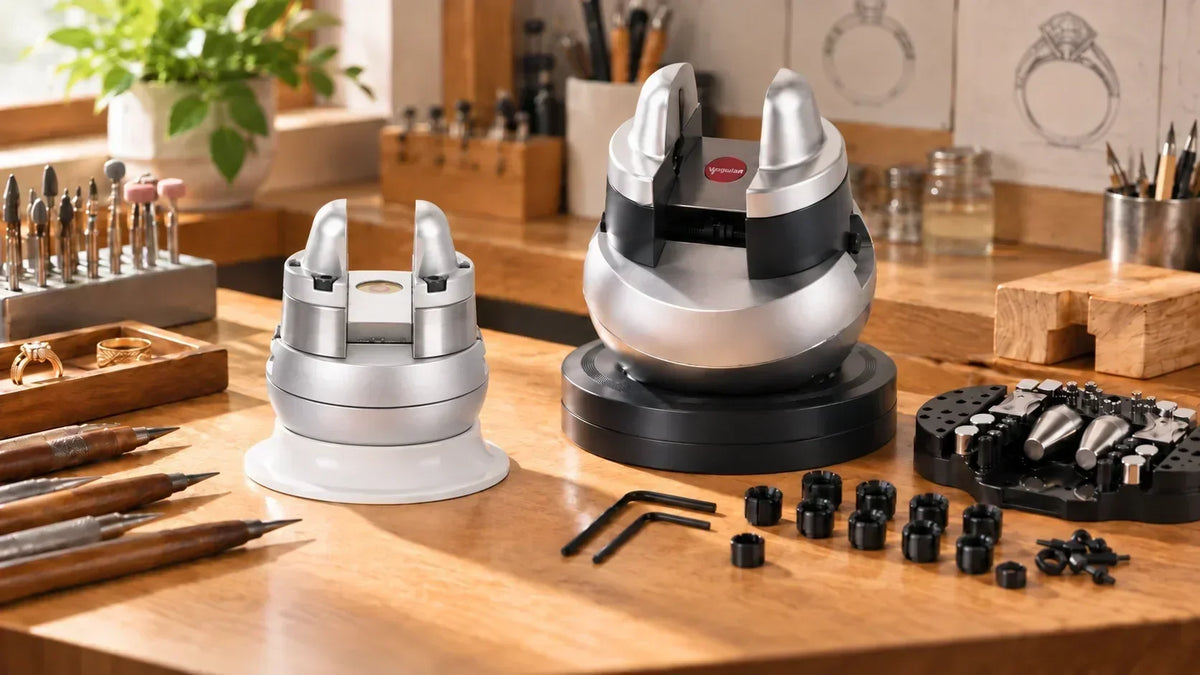
A ball vise does not cut, set or engrave a piece; it makes those operations easier to control by holding the work at a useful angle. The right size depends on jaw opening, workpiece scale, available bench space and how much stability the task needs—not simply on whether a larger ball appears more professional.
Start With the Workpiece, Not the Vise
The Tooltos 3-Inch Ball Vise has a 47 mm maximum jaw opening and 38 mm jaw width. At 2.6 kg, it is intended for rings, small pendants and compact workpieces where a light, smaller-footprint holder is useful.
The Tooltos 5-Inch Ball Vise opens to 98 mm, with 64 mm jaw width. Its 10.2 kg galvanized-steel body is a better match for larger rings, pendants, bracelets and other jewelry-scale pieces that need more support during detailed work.
Measure the part and the fixture you will actually clamp. Jaw opening alone is not the usable work area: a raised setting, an irregular back or a fragile surface may need protective jaw plates or a dedicated attachment.
Compare Stability Against Repositioning
The 3-inch model is easier to move and leaves more working room on a crowded bench. This suits a station that changes between small repair, engraving and setting tasks, or a workpiece that needs to sit close to the operator.
The 5-inch model is much heavier. That additional mass helps it remain steady under normal engraving and setting pressure, but it also makes it a more permanent bench fixture. Choose it when stability and larger workholding range matter more than portability.
Rotation and the Brake Are Core Features
Both models provide 360-degree swivel movement with adjustable resistance and double-ball-bearing rotation. Set lighter resistance when you need frequent small changes in workpiece angle; lock the swivel when the piece must not move under a graver or stone-setting tool.
A self-centering jaw makes symmetrical rings and round pendants easier to position. It does not automatically solve every shape. Use compatible attachments and take time to secure irregular pieces rather than relying on jaw pressure alone.
Build the Workholding Setup Around the Job
Use jaw plates or other suitable protection to avoid marking delicate surfaces. Confirm that the clamping points are away from stones, thin edges and finished areas. Before starting a cut or setting operation, check the swivel resistance, jaw security and the clearance for your hands and tool path.
Keep the ball and bearing mechanism clean and follow the supplied maintenance guidance. A smooth vise is useful only when it remains stable and does not transfer debris to the jewelry.
A Quick Decision
Choose the 3-inch model for compact jewelry, limited bench space and a lighter workholding solution. Choose the 5-inch model when you routinely handle larger pieces, need up to 98 mm jaw opening and want the stability of a 10.2 kg base.
Neither model replaces appropriate fixtures for irregular work. The correct ball vise is the one that holds the actual piece securely, rotates when you need it to and locks when the operation demands it.
Contact Us
If you have questions about choosing a ball vise or building your engraving and stone setting setup, our team is happy to help. Reach us at sales@tooltos.com, and we will get back to you as soon as possible.
0 commentaire