

A spinner ring needs two separate bands: an inner band that sits on the finger and an outer band that turns around it. The moving joint comes later, but the process starts with forming. If either band is oval or uneven, smooth, controlled rotation becomes harder to achieve.
The key distinction
A ring-bending tool helps establish the starting curve. Roundness checks, working clearance, and retaining edges still need to be handled during fitting and assembly.
Start with repeatable ring forming
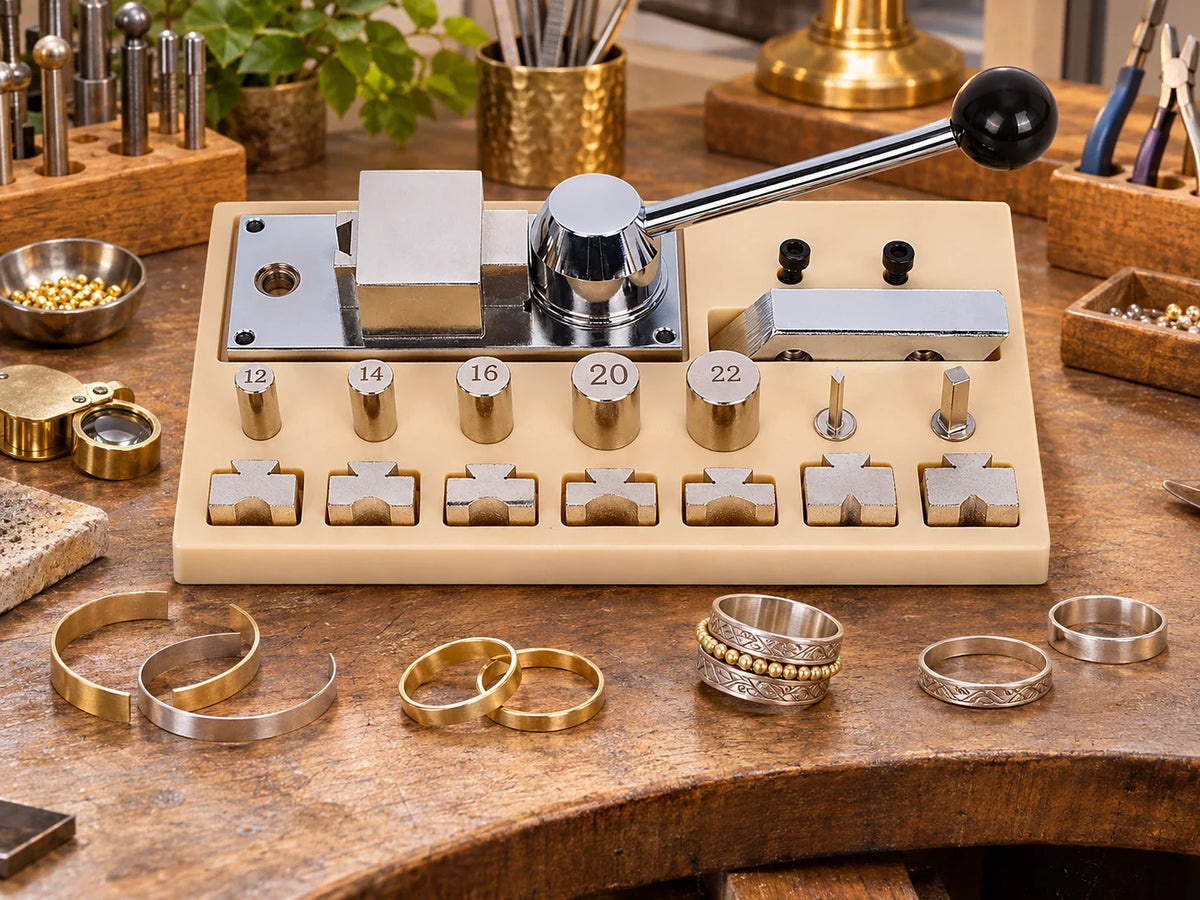
The Tooltos IV Ring Bending Tool with Plastic Base is a manual forming tool for compatible non-ferrous metal. For a spinner ring, its role is to establish a consistent initial curve in the inner and outer components before fitting and finishing.

Metal strip
Up to 2 mm (0.08 in) thick
Wire
Up to 3 mm (0.12 in) diameter
Profile options
Five round molds and two angle formers
The interchangeable molds include round forms of 12, 14, 16, 20, and 22 mm (approximately 0.47, 0.55, 0.63, 0.79, and 0.87 in), plus 60-degree and 90-degree profiles.
Select the mold for the intended component diameter, not solely for the final finger size. The inner band, outer spinner band, and retaining edges have different jobs. Form each band as a separate component, then check how the chosen profiles relate before committing to final assembly. Mold diameter is a forming reference, not a guarantee of the finished ring size.
The tool does not create a finished spinner ring, set a working clearance, or install a bearing. It helps reduce variation at the forming stage so the later fitting process begins with more consistent bands.
Keep the two bands round and compatible
The outer band needs a small working gap around the inner band. Clearance depends on the metals, band widths, and finishing process, so establish it with trial pieces rather than a generic measurement.
| Fit condition | What to watch for |
|---|---|
| Too tight | The outer band can bind as it turns. |
| Too loose | The outer band can rattle. |
Give both bands the same attention to roundness. An outer band may look correct from above yet have a tight point when it turns around the inner band.
Before closing the retaining edge
- Check each band on a suitable mandrel.
- Test the assembled pair through a full rotation.
- Look for tight points rather than relying on appearance alone.
Use the right material condition for forming
The Tooltos IV model is intended for gold, silver, copper, brass, and other compatible non-ferrous alloys. Metal condition still matters. Annealing an appropriate alloy before forming can reduce springback and make the curve more predictable, especially with thicker stock. Follow the alloy supplier's recommendations, use suitable heat-safety precautions, and work within the tool's stated capacity rather than forcing material through an unsuitable die.
For a moving design, keep contact surfaces free of deep dents, burrs, and sharp tool marks. These imperfections can become drag points once the outer band is captured. Plan decorative textures and surface work so they remain outside the rotational interface where possible.
Build the moving joint after fitting
In a flared-edge spinner ring design, the retaining edges on the inner band keep the outer band in place.
- Prepare the first edge. Form and finish the first retaining edge.
- Fit the spinner band. Confirm that the components turn together as intended before final retention.
- Close gradually and recheck. Build or close the second edge in small steps, checking movement repeatedly rather than using one forceful press.
This gradual approach helps limit distortion and preserve the clearance established during fitting.
Ball bearings are not a drop-in substitute for this interface. A bearing-based design needs a precise race, reliable retention, and consideration of sweat and debris. For a conventional handmade spinner ring, a well-fitted metal-on-metal interface offers a simpler starting point for inspection and maintenance.
Choose forming tools by the stage of the job
Use a manual ring-bending tool when the goal is repeatable round or angled starting forms in compatible non-ferrous metal. Use mandrels and fitting checks to refine each component. Then treat the rotating interface as its own assembly step, not as something the forming tool can complete.
For other ring-forming options, browse the Tooltos ring bending tool collection and match the mold range, material capacity, and base style to your bench work. The goal is not simply to bend two bands, but to begin assembly with components that are round, compatible, and ready for careful fitting.
Contact Tooltos
Need help choosing a ring-bending tool or checking product specifications? Contact the Tooltos team at sales@tooltos.com. Share the metal you plan to use, its thickness, and your intended forming task so we can better understand your requirements.
0 commentaire