

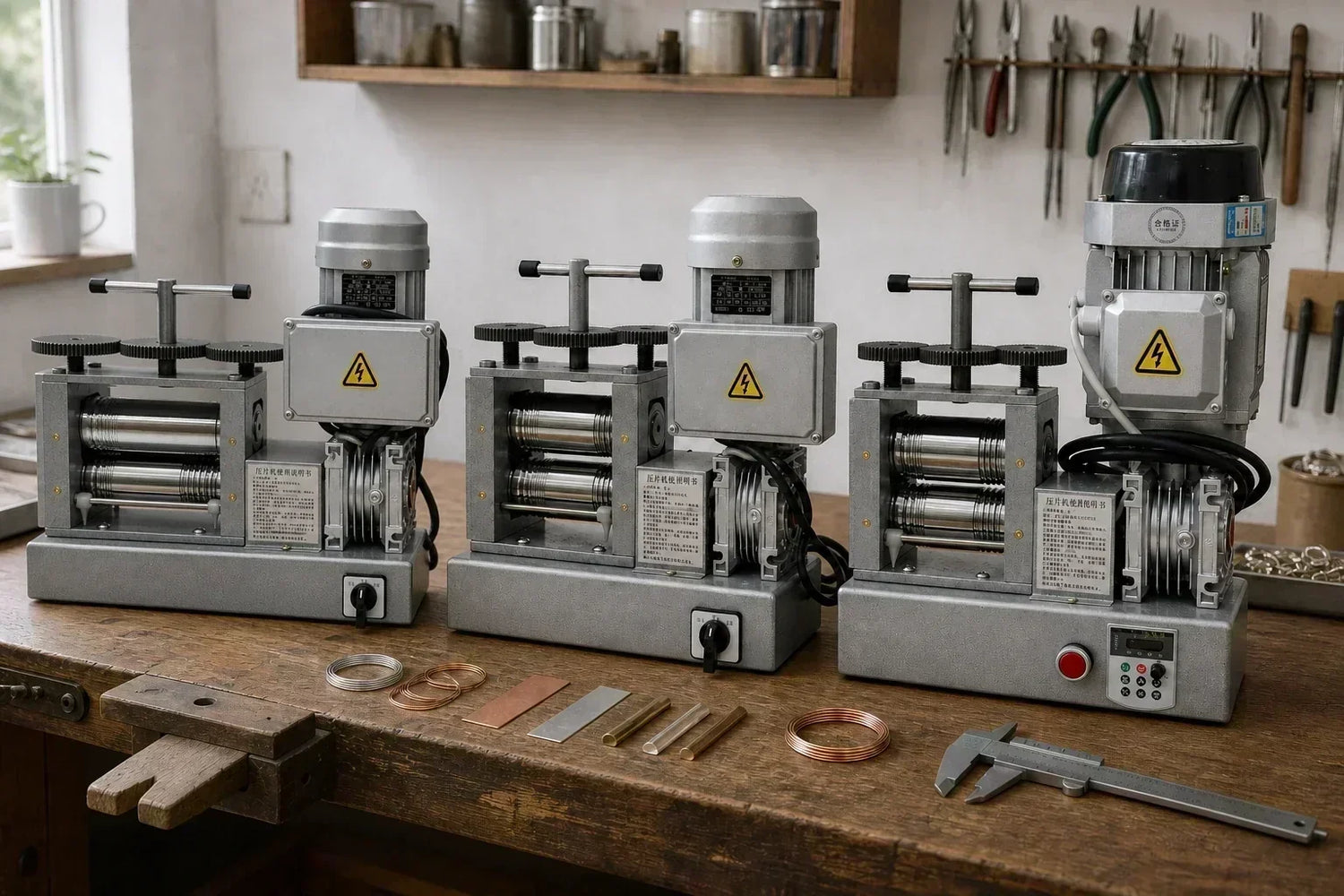
Three rolling mills can share the same 550W motor rating and still suit very different jewellery workshops. The real choice is not simply about power — it is about the metal profiles you make, the width of flat stock you need to roll, and whether adjustable speed matters in your daily workflow.
Quick Answer
- Tooltos 550W 3-in-1 Electric Jewelry Rolling Mill — if your work mainly involves square wire, half-round wire and narrow flat sections.
- Tooltos 550W 4-in-1 Electric Jewelry Rolling Mill — if you also need round-wire grooves and a wider 50mm flat rolling area.
- Tooltos 550W Variable Speed Electric Jewelry Rolling Mill — if you need the broader forming range together with adjustable working speed.
Quick Comparison
| Feature | 550W 3-in-1 | 550W 4-in-1 | 550W Variable Speed |
|---|---|---|---|
| Speed control | Fixed (forward / stop / reverse) | Fixed speed | Variable speed |
| Flat sheet rolling | Yes — 6.2mm width | Yes — 50mm width | Yes — 50mm width |
| Square wire | 1–7mm (8 grooves) | 1–6mm (7 grooves) | 1–6mm (7 grooves) |
| Half-round wire | 4–10mm (6 grooves) | 2–6mm (5 grooves) | 2–6mm (5 grooves) |
| Round wire | — | 1.5–6mm (6 grooves) | 1.5–6mm (6 grooves) |
| Roller size | — | 70mm dia × 160mm | 70mm dia × 160mm |
| Net weight | ~46.7 kg | ~46 kg | ~45.5 kg |
| Best for | Wire-focused studios | Versatile multi-function studios | Frequent rolling & speed control |
Groove dimensions are nominal. Finished dimensions can vary with alloy, hardness, annealing condition and rolling technique.
What All Three Rolling Mills Have in Common
All three models use a 550W electric drive and are offered in 110V and 220V versions. They are designed for non-ferrous jewellery metals such as gold, silver, copper and brass, and are not intended for steel, stainless steel, hardened metal or general industrial plate processing.
Each machine removes the repeated hand-cranking required by a manual rolling mill — especially useful for workshops preparing sheet and wire stock throughout the working day. An electric motor does not, however, replace correct metal preparation: the workpiece still needs to be annealed when required, aligned carefully, and reduced gradually over multiple passes.
When the 550W 3-in-1 Rolling Mill Makes Sense
 The 3-in-1 model is the most focused of the three. It supports flat sheet, square wire and half-round wire forming, but it does not include round-wire grooves. Its square-wire range extends to 7mm and half-round grooves to 10mm — worth considering for larger bezel, border or decorative wire profiles.
Important: its 6.2mm flat section means it should not be selected as a general wide-sheet mill.
✓ Choose if you…
- Mainly form square and half-round wire
- Do not require round-wire grooves
- 6.2mm flat section is sufficient
- Forward / stop / reverse control is enough
✗ Avoid if you…
- Regularly roll flat stock wider than 6.2mm
- Need round-wire forming
- Want adjustable feed speed
When the 550W 4-in-1 Rolling Mill Is the Better All-Rounder
 The 4-in-1 model adds round-wire forming to flat sheet, square wire and half-round wire work, and provides a 50mm flat rolling width. One machine can prepare flat material for ring blanks and pendants, square wire for settings, half-round wire for bezels, and round wire for chains and clasps. The trade-off is a fixed speed: if you are comfortable aligning material before each pass, that may be entirely adequate.
✓ Choose if you…
- Need flat, square, half-round and round forming functions
- Need a 50mm flat rolling area
- Make a varied range of jewellery components
- Want broader forming capability without paying for variable speed
When Variable Speed Is Worth Choosing
 The variable-speed model shares the same 70mm × 160mm roller format, 50mm flat width and groove ranges as the 4-in-1. Its defining difference is adjustable speed control. Lower speed gives more time to align narrow wire or begin a delicate pass; a higher speed improves efficiency during repeated reductions. Variable speed is most valuable when a studio rolls metal frequently or needs more control at the start of a pass.
✓ Choose if you…
- Perform rolling work regularly rather than occasionally
- Want slower feed for alignment and delicate work
- Process both sheet and several wire profiles
- Value workflow control more than choosing the lowest-cost 550W option
A Practical Decision Checklist
- List the profiles you actually make. If round wire is part of your normal work, remove the 3-in-1 from the shortlist.
- Measure the flat stock you expect to roll. Choose the 4-in-1 or variable-speed if the 3-in-1's 6.2mm flat section is too narrow.
- Decide whether speed adjustment solves a real problem. Variable speed aids alignment and process control but is not necessary for every studio.
- Confirm the groove sizes. The 3-in-1 reaches larger square and half-round nominal sizes; the other two add round-wire grooves.
- Check workshop power and placement. Select the correct 110V or 220V version and plan for a stable surface supporting approximately 45–47 kg.
- Confirm the metal. These machines are intended for non-ferrous jewellery metals — not hardened steel or industrial production stock.
Better Rolling Starts Before the Motor Is Switched On
Whichever model you choose, good rolling practice matters more than the motor rating:
- Anneal the metal when required to reduce work hardening and the risk of cracking.
- Reduce thickness gradually across multiple passes — never force a large reduction at once.
- Start with a groove slightly larger than the target profile and step down in stages.
- Align the workpiece with the selected groove before starting the pass.
- Keep roller surfaces clean and follow the machine manual for lubrication and maintenance.
- Disconnect from power before cleaning or maintenance.
Frequently Asked Questions
Q: What is the main difference between a 3-in-1 and 4-in-1 jewellery rolling mill?
The 3-in-1 model rolls flat sections, square wire and half-round wire. The 4-in-1 model adds round-wire grooves and provides a wider 50mm flat rolling area.
Q: Does a variable-speed rolling mill have more power?
No. All three models are rated at 550W. The variable-speed model adds adjustable working speed rather than a higher motor-power rating.
Q: Can these rolling mills process steel?
No. The specifications describe them for non-ferrous jewellery metals such as gold, silver, copper and brass. They are not intended for steel, stainless steel or hardened metals.
Q: Which model is best for a small jewellery studio?
Choose by workflow rather than studio size. A wire-focused studio may prefer the 3-in-1; a varied studio benefits from the 4-in-1; a workshop rolling metal frequently may value the variable-speed model's additional control.
Q: Do I still need to anneal metal when using an electric rolling mill?
Yes. Electric drive reduces hand effort, but it does not prevent work hardening. Proper annealing and gradual reductions remain essential parts of jewellery metal forming.
Final Recommendation
The best rolling mill is the one that matches the profiles and stock sizes you use most often:
- 550W 3-in-1 Electric Jewelry Rolling Mill — focused choice for square wire, half-round wire and narrow flat work.
- 550W 4-in-1 Electric Jewelry Rolling Mill — strongest all-round choice for four forming functions and wider flat rolling.
- 550W Variable Speed Electric Jewelry Rolling Mill — best for frequent rolling and workshops that value adjustable feed control.
Before ordering, confirm the current product specifications, select the correct voltage, and contact the Tooltos team if you need help matching groove sizes to your production workflow. You can also browse the full Tooltos Jewelry Rolling Mills & Forming Tools collection for more equipment.
0 commentaire