

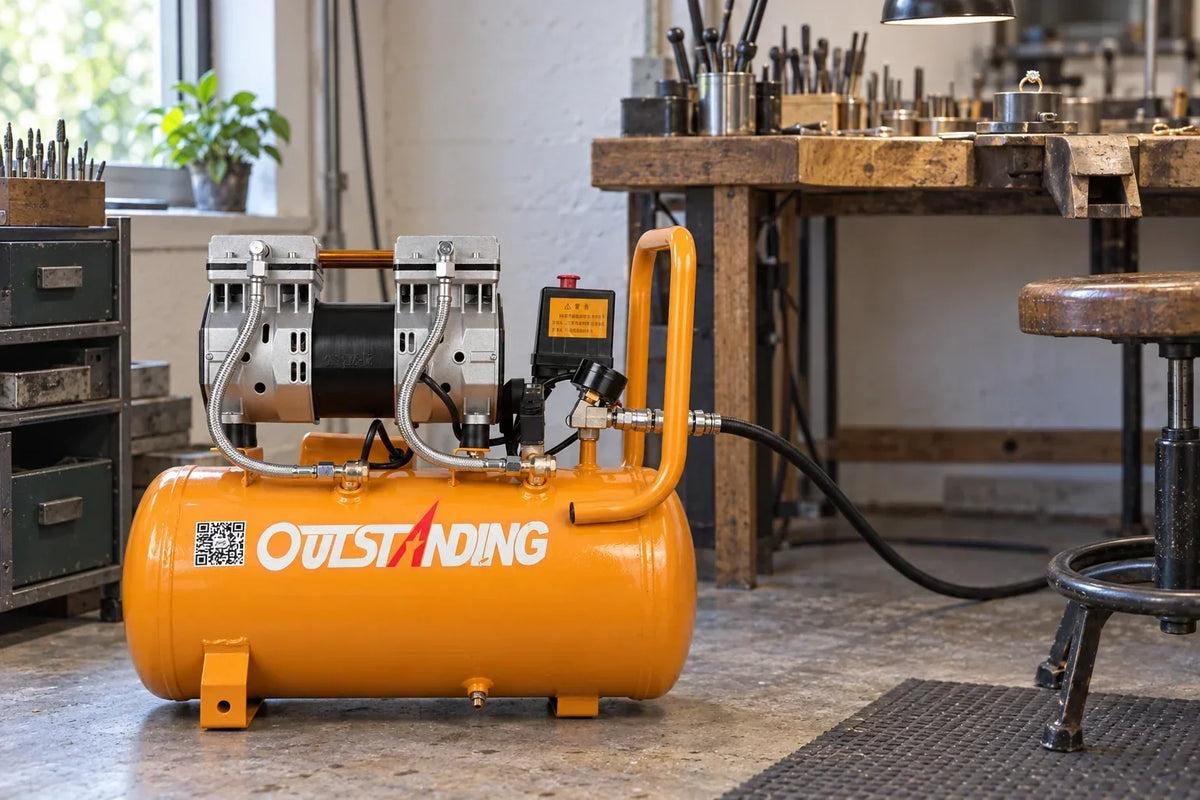
Pneumatic jewelry tools depend on the air supply as much as on the handpiece. An undersized, wrongly powered, or poorly placed compressor can make a capable tool inconsistent at the bench.
This guide uses the Tooltos 30L Oil Free Silent Air Compressor as a reference. Tooltos lists it for pneumatic jewelry engraving machines, graver helpers, and air-powered bench tools.
At a Glance
- 220V, 1600W motor
- 30L tank
- 140 L/min nominal flow
- 0.7 MPa exhaust pressure
- 520 × 240 × 530 mm, 21.5 kg
Step 1Confirm Tool and Compressor Compatibility
Start with the tool, not the compressor. Record the tool's required pressure and air consumption, then compare both figures against the compressor's output. For example, the Tooltos 8000RPM dual-handpiece engraver specifies 0.15–0.25 MPa (approx. 22–36 psi), while the compressor's 0.7 MPa (approx. 101.5 psi) exhaust pressure is its available output rather than a setting for every tool.
Use the tool's regulator to set the working pressure, and if several tools operate together, plan for their combined demand.
Step 2Check the Power and Bench Location
This 30L compressor runs on 220V only, so confirm your local power supply before ordering. Its listed dimensions are 520 × 240 × 530 mm (approx. 20.5 × 9.4 × 20.9 in) and its weight is 21.5 kg (approx. 47.4 lb), so measure the installation space and the hose route to the bench in advance.
Step 3Connect Clean Air to the Tool
The kit includes an air hose, blow gun, quick connector, mufflers, wheel set, and mounting hardware. Inspect the hose and quick connectors for leaks before use, then connect the tool's own filter or regulator as required.
An oil-free pump avoids oil filling and reduces the risk of oil contamination, but it does not remove the need to manage moisture in the air system.
Step 4Bring the System Up to Pressure
Allow the compressor to reach cut-out pressure and stop automatically before you begin work. Then set the tool-side regulator gradually while watching the gauge. Pressure stability and sufficient flow at the tool's actual requirement matter more than motor power alone.
Test the system first with no workpiece attached. Listen for leaks, check the connections, and confirm that the handpiece responds consistently before starting detailed engraving or other production work.
Step 5Drain Moisture After Each Session
Compressed air creates moisture inside the tank, and Tooltos instructs users to drain the tank after each session. This helps reduce internal corrosion.
Common Setup Mistakes
- ✕Selecting only by tank size or wattage instead of the tool's pressure and flow needs.
- ✕Treating the compressor's maximum output pressure as the required tool setting.
- ✕Choosing a 220V machine for a workshop without compatible power.
- ✕Crowding the compressor so it cannot ventilate properly.
- ✕Leaving moisture in the tank between sessions.
- ✕Ignoring a leaking hose or quick connector.
Final Check Before Buying
The 30L Tooltos compressor is a practical fit for a 220V jewelry workshop that needs a clean air source for compatible pneumatic bench tools.
Before it becomes part of your workflow, confirm:
- ✓Voltage
- ✓Required pressure
- ✓Air consumption
- ✓Installation space
- ✓Maintenance routine
Need Help Matching Air Supply to a Tool?
Share your pneumatic tool model, required pressure, air consumption, and available power supply with the Tooltos team before ordering. Those details determine whether the compressor and tool are a suitable pair.
0 commentaire