

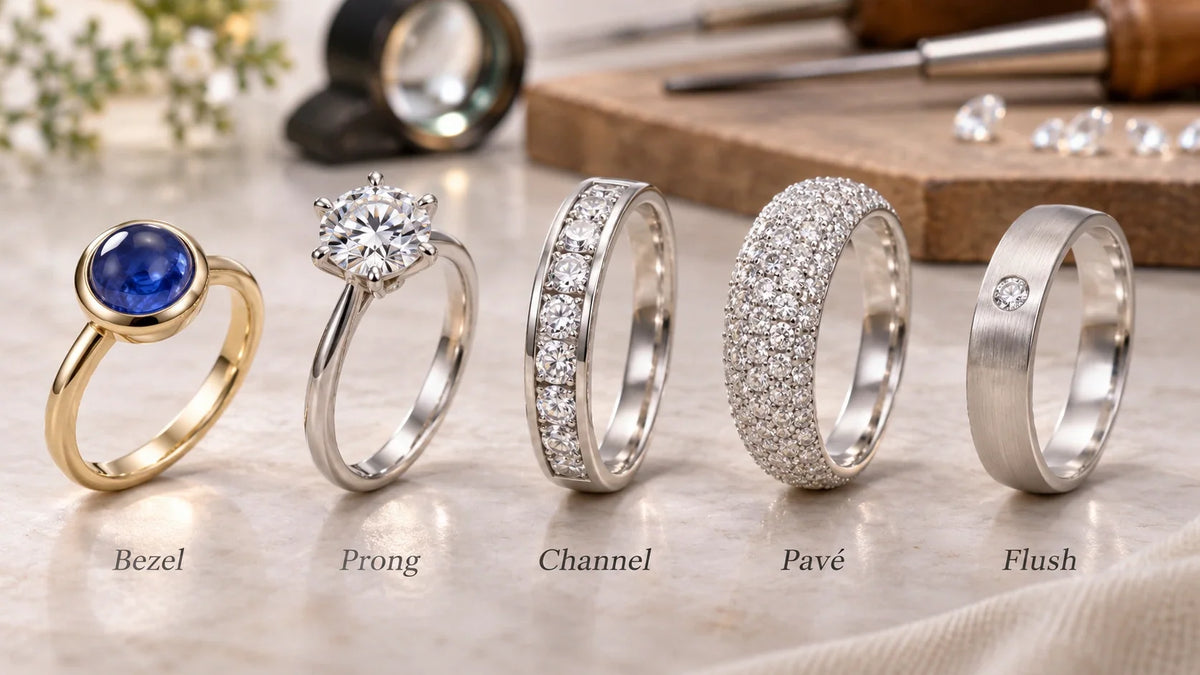
The same gemstone can look completely different in two rings. Set it inside a narrow metal rim, and the design feels smooth and understated. Hold it above the band with prongs, and the stone becomes the first thing you notice.
A jewelry stone setting does more than hold a gemstone in place. It shapes the piece’s appearance, determines how much of the stone is exposed, and influences how the jewelry is worn and maintained. This guide compares five common setting types: bezel, prong, channel, pavé, and flush, with the benefits and tradeoffs of each.
Bezel settings
A bezel setting surrounds the edge of a gemstone with a rim of metal. The rim is shaped over the stone’s edge to help hold it in place.
Bezels have a clean, continuous appearance. They can suit round stones as well as irregular shapes, particularly cabochons with smooth, domed tops. Because the metal covers the perimeter, a bezel can offer useful protection to a stone’s edge.
The tradeoff is visibility: more metal surrounds the stone than in many prong designs. The height and thickness of the bezel also affect the final look. A broad rim can feel bold and architectural, while a narrow rim gives the stone more visual space.
A good fit for: designs that call for a smooth outline, edge coverage, or a contemporary appearance.
Prong settings
Prongs are small sections of metal that extend over selected points of a gemstone. Instead of surrounding the entire edge, they leave more of the stone visible.
A prong-set stone can sit high above a ring band or pendant, creating a prominent focal point. Prong number, shape, and placement all change the look: rounded prongs can feel soft and traditional, while pointed prongs create a sharper outline.
That exposure comes with a tradeoff. A raised setting may catch on clothing or receive knocks during wear. Vulnerable points need appropriate support, and prongs should be inspected periodically for wear or movement.
A good fit for: designs that put the gemstone at the center of attention and show more of its shape.
Channel settings
In a channel setting, stones sit in a row between two walls of metal. This style is often seen along ring bands, where a line of small stones adds detail without making each stone a separate focal point.
The appeal is continuity. Rather than seeing individual settings, the eye follows a clean line across the piece. Stone dimensions and spacing matter because differences become more noticeable when several stones sit next to one another.
A channel also has practical limits. The stones and metal walls need to work together, and repairs or ring resizing can be more involved than on a plain band.
A good fit for: rows of stones and designs that favor a continuous, orderly line.
Pavé settings
Pavé uses small stones placed close together, with tiny beads or sections of metal holding them in place. The visual effect is a surface of closely spaced sparkle rather than one dominant gemstone.
Pavé can frame a center stone, follow a ring band, or add detail to a pendant. From a distance, it reads as texture and light. Up close, the regularity of the stones and the metal between them becomes important.
Because the stones and retaining metal are small, this is detailed work. A finished piece also needs careful inspection and maintenance; a loose or missing stone can change the appearance of the entire surface.
A good fit for: adding fine sparkle across a surface without relying on one large stone.
Flush settings
In a flush setting, the gemstone sits in an opening in the metal with its top close to the surrounding surface. The metal around the opening is worked to secure the stone.
The result is compact and understated. A small stone can appear almost embedded in the band or plate, making this style useful when the maker wants a low-profile detail.
Successful flush setting depends on more than the stone’s diameter. The metal needs sufficient thickness for the stone and the intended setting work. A stone that is too deep for the available metal may need a different design.
A good fit for: small accents, simple bands, and designs where a low profile matters.

How to choose the right stone setting
Start with the stone, then consider the piece. A delicate edge may benefit from more surrounding metal; an unusual shape may need a setting designed specifically around it. A ring worn daily faces different contact and wear from a pendant.
Next, decide what the setting should contribute visually:
- Choose a bezel for a continuous metal outline and edge coverage.
- Choose prongs to make more of the stone visible.
- Choose a channel for an orderly row of stones.
- Choose pavé for a field of fine sparkle.
- Choose a flush setting for a compact, low-profile accent.
No setting is the best choice for every gemstone. The strongest design brings the stone, the metal, and the way the jewelry will be worn into balance.
For makers preparing to practice these techniques, explore Tooltos jewelry engraving and stone setting tools and choose tools according to the setting and workpiece.
Contact Tooltos
Have questions about choosing tools for your stone setting projects? Contact the Tooltos team at sales@tooltos.com.
0 Kommentare