

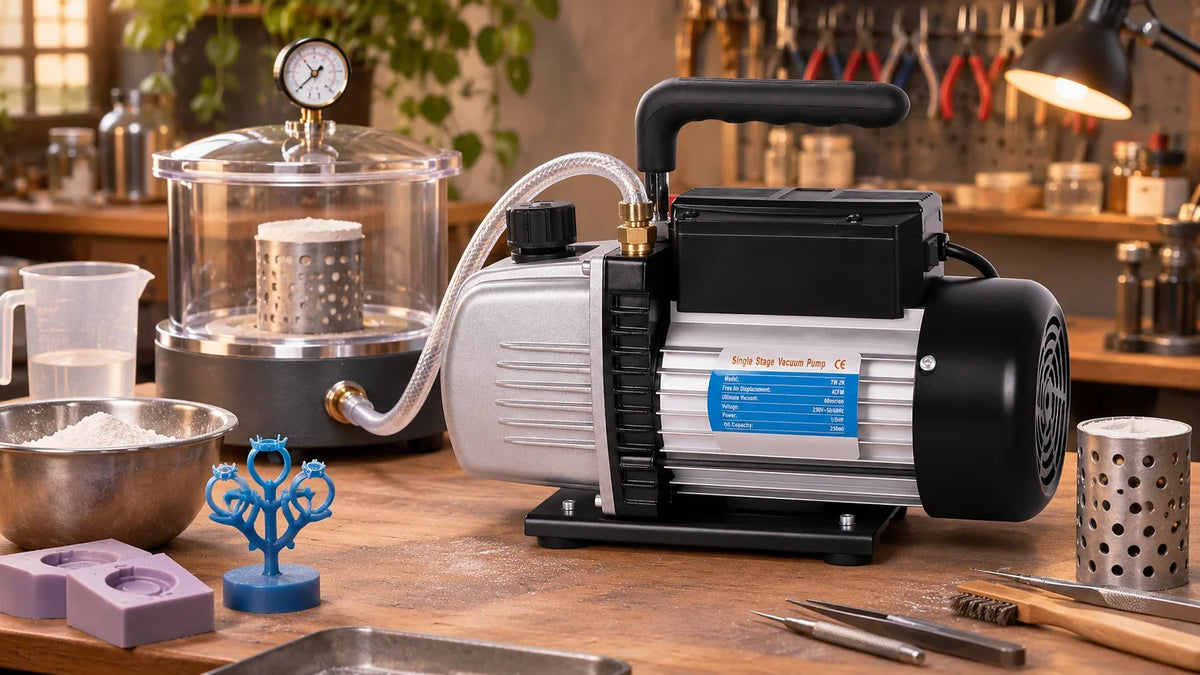
An external vacuum pump can be an important part of a small lost-wax jewelry casting setup. It can support investment degassing and vacuum-assisted casting with compatible equipment. But it does not melt metal, remove wax from a flask, or correct every casting defect.
Choose a pump around the chamber, hose connections, casting process, and production rhythm it will support, not as a standalone promise of better castings.
The practical takeaway: Match the pump to the complete system first. A higher flow rating cannot compensate for leaks, incompatible equipment, or an unsuitable casting process.
Start with the Process Stage
Vacuum has different roles during investment preparation and casting. Keep these operations separate when planning your equipment and timing.
| Process stage | What vacuum contributes |
|---|---|
| Investment preparation | Helps remove trapped air from mixed investment and around the wax model. |
| Vacuum-assisted casting | A compatible system applies vacuum to help molten metal fill the mold. |
What it cannot replace: A vacuum pump cannot replace a burnout furnace. The flask still needs a suitable burnout cycle to remove wax and prepare the mold. Nor can the pump replace a melting furnace or a casting and melting machine. Adding a pump alone does not complete the workflow.
Match the Pump to Compatible Equipment
Before buying, confirm that your investing or casting equipment requires an external pump. Some compact systems have a built-in pump; others need a separate unit.
Your Prepurchase Check
- Connections: Check the equipment's connection size and hose requirements.
- Operating requirements: Read the instructions for both the pump and the equipment it will support.
- Power supply: Confirm the voltage at your bench before selecting a version.
The Tooltos 4CFM 1/3HP Single Stage Professional Vacuum Pump is listed for jewelry vacuum casting and wax injection machines.
Airflow: 4 CFM at 50 Hz or 4.8 CFM at 60 Hz.
Voltage options: Separate 110V and 220V versions. Select the version that matches your power supply and follow the supplied connection and operating instructions.

Do Not Choose by Flow Rate Alone
Airflow Is Only Part of the Picture
CFM describes airflow capacity. It does not tell you whether a pump is suitable for every flask, vacuum chamber, or casting table. Chamber volume, hose condition, seal quality, leaks, and work volume all affect practical performance.
The Complete Vacuum Path Matters
An ultimate-vacuum specification is not a guarantee of the vacuum your assembled system will achieve. A poor chamber seal, worn gasket, or loose hose can limit performance even when the pump itself is working. Check the complete vacuum path rather than treating the pump rating as the result at the flask.
Build a Repeatable Operating Routine
Keep the pump level, with access to the oil viewing window, drain point, inlet, and exhaust area. The Tooltos pump has a 250 ml oil capacity, an oil viewing window, an inlet strainer, and an exhaust trap.
Oil reminder: Follow the supplied oil requirements and maintenance instructions rather than treating the stated capacity as a routine refill quantity.
-
Before each session
Inspect hoses, connections, gasket surfaces, and the chamber. Check the oil as directed in the manual. -
During operation
Monitor the system and follow the equipment's operating limits. Do not leave it unattended. -
Between sessions
Address contamination, worn seals, or changes in vacuum performance before the next casting run.
Diagnose the Stage Before Blaming the Pump
Incomplete fill, rough surfaces, porosity, and investment failure can have causes beyond the vacuum system. Wax design, sprue layout, investment mixing, burnout, metal and flask temperatures, and casting technique all affect the result.
A Simple Troubleshooting Sequence
- Identify the process stage where the problem appears.
- Check the vacuum path for leaks, then review the relevant preparation and casting steps.
- Change one variable at a time and record the result so that troubleshooting becomes repeatable rather than guesswork.
Choose the Workflow Then Choose the Pump
Need an external unit? Select it as part of the complete setup, with compatibility and operating requirements checked first.
Need a self-contained option? Compare machines with built-in vacuum systems. Explore the Tooltos Jewelry Vacuum Casting Machines collection by workflow, supported flask size, and production volume, rather than making pump size the deciding factor.
Contact Tooltos
Need help choosing a vacuum pump or checking equipment compatibility? Contact the Tooltos team at sales@tooltos.com. Include your equipment model, power supply voltage, and intended application so we can better understand your setup.
0 comentarios