

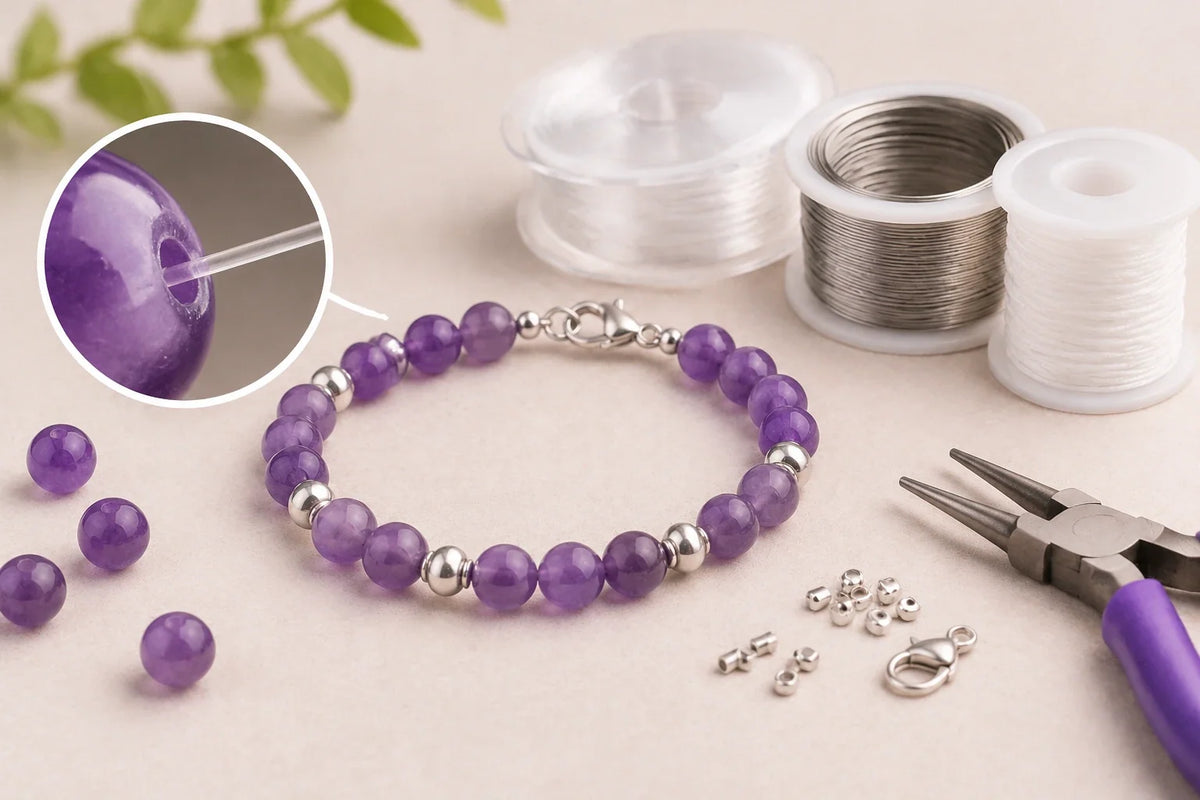
Clear fishing line is easy to find, visually subtle, and passes through small bead holes. But that does not make it the right choice for every beaded bracelet or necklace. It can become brittle, wear against sharp bead edges, form a bulky knot, or fail where the design bends most often.
Choose the stringing material around the finished piece rather than around what is already on the bench. The bead hole, bead edge, movement, closure, and expected wear all matter.
Start with the bead hole and edge
The stringing material should move through the hole without force. A thick line in a small hole can damage the line, chip a brittle bead, or create unnatural drape. Test a short sample through several beads first.
Look at the edges inside the hole. Glass, crystal, metal, ceramic, and rough-drilled stone beads can act like abrasives. A line that passes a gentle pull test may still wear through after repeated movement. Limit movement at sharp-edged beads or choose a better-matched material.
Decide whether the design needs stretch
Stretch cord is useful when a bracelet must slip over the hand without a clasp. It is not ordinary clear monofilament. Repeated stretching, heavy beads, and rough holes shorten its working life.
For a necklace, fixed-length bracelet, or controlled drape, a non-stretch material is more predictable. Do not add stretch to solve a closure problem that needs a clasp or adjustable construction.
Match the material to the construction

Flexible beading wire suits a clasped strand with clean, consistent movement. Finish it with compatible crimps and end components rather than a simple knot. Crimp covers can conceal the finished crimp, but do not replace it.
Braided beading thread works for multiple passes and woven structures, but test its knots and abrasion behavior with the exact beads.
Cord suits designs where knots, texture, or larger holes are part of the look. Its end or knot must fit the finding and remain secure. Fishing line can suit a lightweight, low-abrasion project, but should be a deliberate choice.
Plan the closure before stringing
The end of the strand determines much of the material choice. Decide on a clasp, sliding knot, crimped loop, or fixed knot early. Then check whether the stringing material can pass through the relevant components enough times for a secure finish.
Avoid a single oversized knot where it can rub skin, pull through a bead, or catch inside a clasp. Make a short end sample, flex it several times, and check that the finish remains compact.
Test real movement rather than a single pull
The weak point is often the first bead beside the clasp, a bend around a pendant, or the location where passes cross. Flex these points repeatedly. Check whether the line whitens, frays, flattens, loosens at a knot, or catches.
For a necklace holding a removable object or an everyday bracelet, test beyond bead loading. Open and close the clasp, bend the strand as during wear, and inspect again. Replace questionable material before final finishing.
Build the design around serviceability
All stringing materials wear eventually. Leave space near the closure, keep the layout repeatable, and record the material for future restringing.
The best alternative to fishing line is not one universal cord. It is the material that fits the bead holes, protects against abrasion, supports the intended closure, and behaves predictably in the finished design.
For layout and assembly tools used in beadwork and wire-based designs, explore Tooltos wire wrapping and beading tools.
Contact Tooltos
Have questions about Tooltos beading tools or need help choosing tools for your project? Contact us at sales@tooltos.com.
0 comentarios