

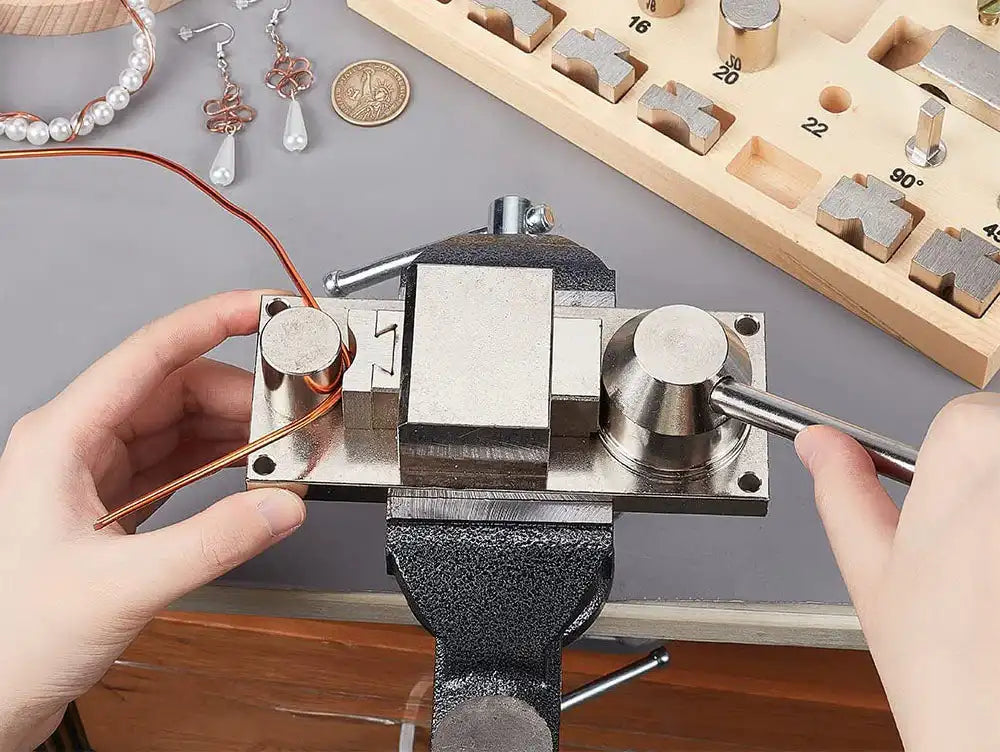
Ring benders and bracelet benders are specialized jewelry tools for shaping metal bands into circles and curves. They work by clamping a strip or wire and forcing it around a fixed mandrel or die. Because bending work-hardens metals like silver and gold, jewelers typically anneal the stock first to keep it soft and avoid cracks.
Principles of Operation
All bending tools rely on plastic deformation. One end of the ring or cuff blank is clamped, and the free end is gradually forced past its yield point around a curved die or bar. As the metal bends, it takes the shape of the die. Many bench benders include sets of matching dies — for example, half-round or flat dies — so the jeweler can choose the right radius. In practice, jewelers often bend the band twice: first to an approximate size, then on a slightly smaller form to snug the ends. Slow, incremental bending with frequent checking on a mandrel ensures a uniform curve.
Manual Bending Tools
Ring Benders (hand tools)
The simplest tools are plier-style benders with curved or flat jaws to bend wire or strip. Sturdy steel bending pliers can shape heavy stock (up to about 10 ga / 2.6mm thick) into rings or coils. The jaws are often padded with nylon or Delrin inserts to grip without marring the metal. In use, the jeweler closes the plier a bit, slides the strip along the jaws, then closes more — repeating until a full circle is formed.
Bench Ring Benders
More heavy-duty devices bolt to the bench and use a lever arm. The jeweler clamps the ring blank between precision hardened and ground dies and operates the lever to curve the metal. Bench ring benders often come with multiple interchangeable dies, including a nylon-die option so soft metals are not scratched. These are ideal for making perfectly fitted rings, as a small additional push on a slightly smaller die snugs the seam tight for easier soldering.
Bracelet Benders (hand tools)
A classic bracelet bender is essentially a clamping jig for cuffs and bangles. One end of a cuff blank is tightened into a screw clamp, and a free cylindrical bar acts as the form. The user secures one end of the bracelet, tightens it down, then uses both thumbs to push the metal up and over the bar. The operation is repeated on the other side. Because this tool has fixed curves, it reliably produces the correct cuff radius every time.
Hydraulic and Powered Bending Machines
For large production or very stiff work, powered presses are used. A cam-operated press lets a single operator exert great force with minimal effort, bending rings, cuff bracelets, and bangles in one station without hydraulics. It comes with an assortment of forming dies that match typical jewelry profiles.
Larger shops may use a hydraulic bench press. Even a compact 10-ton press is suitable for a studio environment. Operators place the band between the platens or over an inserted die and pump the hydraulic ram to bend the metal. These machines excel at very thick metal or multiple bends that would be tiring by hand.
Materials and Metal Types
Ring and bracelet benders work with soft and malleable metals. Sterling silver, gold alloys (10K–22K), copper, bronze, and brass can all be shaped easily. Each tool has a thickness limit: hand-held bending pliers typically handle wire or strip up to about 10 ga (2–3mm), while heavy-duty bench machines can take stock up to about 4mm thick.
For very thick or large pieces, the metal is often annealed between bends to relieve stress and prevent cracking. Polished or plated metals also benefit from plastic dies so the surface is not scratched during bending.
Best Practices for Consistent Shapes
- Use the right form and die — Always choose a mandrel or die that matches your desired final shape. Uniform pressure across the strip is essential for consistent curves without wrinkles or deformities.
- Bend incrementally and check fit — Bend a little, reposition, then bend more. Check frequently against a mandrel. If the band is too open, bend again on a slightly smaller diameter to tighten the fit.
- Prevent surface damage — Use nylon or Delrin dies for softer metals. Slide the strip steadily along the jaws rather than bending at a single point to avoid kinks.
- Anneal as needed — Any time the metal feels resistant or springs back, anneal it. Silver and gold bend easily; copper and brass harden faster and may need more frequent annealing.
- Finish on a mandrel — Once roughly bent, hammer or roll the band on a smooth mandrel to finalize the shape. For rings, tapping with a rawhide mallet on a steel mandrel produces a perfect circle.
Safety and Maintenance
When using any bending tool, always secure bench-mounted tools tightly so they cannot twist under force. Wear safety glasses — if a band springs or a small piece breaks, it can fly out. Keep hands and fingers clear of pinch points near clamping screws and lever pivots.
For powered presses, use both hands on the controls and keep hands away from the die area when the ram is moving. Never exceed the tool's rated capacity.
For maintenance, wipe off filings and debris after use, oil pivot points lightly, and check that all screws are tight before each session. Replace worn or damaged dies promptly — a chipped die will give an uneven bend.
Recommended Bending Tools from Tooltos
- Browse all Tooltos Bending Tools — Ring benders, bracelet benders, and forming tools for professional jewelry studios
Related Guides
Shop Bending Tools
Browse professional ring and bracelet bending tools at Tooltos. Contact us at sales@tooltos.com — we respond within 24 hours on business days.

0 comentarios