

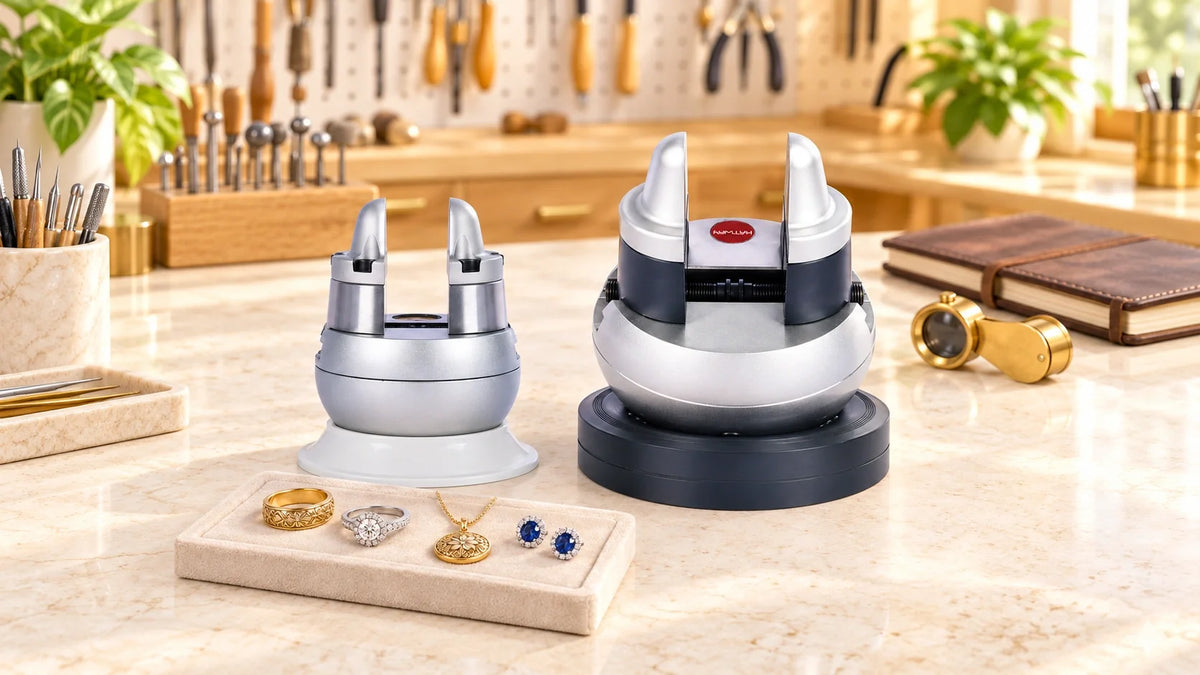
A ball vise is not simply a heavy clamp. For engraving and stone setting, it determines how readily a piece can be turned, held at a repeatable angle, and kept steady under the handpiece or microscope. The right size depends less on the word “professional” and more on the workpiece, the bench, and the way you work.
The short answer
Choose the 3-inch ball vise for rings, small pendants, and compact bench setups. Choose the 5-inch model when you need a wider jaw opening or a heavier base. Both support microscope-assisted work, so check working height and tool clearance rather than choosing by size alone.
Start with the work you hold most often
Rings, small pendants, and compact settings need controlled positioning more than a large jaw opening. A compact vise is often the better fit when bench space is limited. Larger pieces, broad plates, and substantial fixtures may need more capacity and mass.
Before choosing, measure the widest part of the workpiece or fixture you actually need to hold. Also consider the clearance needed for gravers, handpieces, setting tools, and the microscope objective. A vise that can grip the piece but leaves no working room will still slow the job down.
Before you compare sizes
- Measure the workpiece and any fixture, not just the jewelry itself.
- Check the space needed to approach the piece with your tools.
- Confirm comfortable working height and clearance under your microscope.
When the 3 inch ball vise is the better choice

The Tooltos 3-Inch Ball Vise uses self-centering jaws for rings, small pendants, and other compact work. Its 78 mm ball has 360-degree rotation with an internal brake that adjusts from free-spinning to locked. The 38 mm jaws open to a maximum of 47 mm, while the 2.6 kg steel body keeps the tool manageable for a smaller bench.
At a glance: 47 mm / 1.85 in maximum opening · 2.6 kg / 5.7 lb · Compact handling
Choose this format when your normal work is jewelry-scale and you need to turn a piece frequently rather than move around the bench. Adjustable resistance lets you make deliberate angle changes during engraving, then lock the swivel when a fixed position is needed for setting.
When the 5 inch ball vise is the better choice

A larger vise is not automatically more precise, but its wider jaw opening and heavier body can be valuable for large pendants, substantial fixtures, or work that benefits from greater support. The Tooltos 5-Inch Ball Vise has a 130 mm ball, up to 98 mm jaw opening, and a 10.2 kg weight. That extra capacity requires more bench space and makes the vise less convenient to reposition.
At a glance: 98 mm / 3.86 in maximum opening · 10.2 kg / 22.5 lb · Heavier support
Choose the 5-inch format when your work or fixture regularly exceeds the smaller model’s 47 mm opening, provided it fits securely within the larger model’s capacity. It also supports microscope work, but check the complete setup for working height, reach, and clearance before deciding.
3 inch and 5 inch ball vise comparison
The two sizes solve different workholding problems. The 3-inch model prioritizes compact handling; the 5-inch model provides greater jaw capacity and mass. Specifications below come from the Tooltos product listings. Inch and pound conversions are approximate; the model names are nominal sizes.
| Feature | 3 inch ball vise | 5 inch ball vise |
|---|---|---|
| Ball diameter | 78 mm / 3.07 in | 130 mm / 5.12 in |
| Maximum jaw opening | 47 mm / 1.85 in | 98 mm / 3.86 in |
| Jaw width | 38 mm / 1.50 in | 64 mm / 2.52 in |
| Weight | 2.6 kg / 5.7 lb | 10.2 kg / 22.5 lb |
| Rotation control | 360 degrees with adjustable brake | 360 degrees with adjustable brake |
| Typical fit | Rings, small pendants, compact fixtures | Larger pieces and more substantial fixtures |
A wider jaw opening solves a capacity problem. It does not automatically make a vise more precise or a microscope setup more comfortable.
Set the vise up for the task
Use suitable jaw plates to help protect delicate surfaces. For engraving, begin with medium swivel resistance so the piece turns deliberately instead of drifting. For stone setting, lock the swivel when you need a fixed hand position. With irregular shapes, use suitable fixture attachments rather than expecting self-centering jaws to secure every form safely.
Keep the vise close enough to your working position that you can turn the piece without reaching or changing posture. Under magnification, check focus, tool access, and clearance throughout the intended movement before starting. Confirm that the workpiece is secure without applying excessive clamping pressure.
Before the first cut or setting operation
Check three things: the piece is secure, the swivel resistance suits the task, and your tools can reach the working area without hitting the jaws or microscope.
Watch both ball vise sizes in operation
Watch the Tooltos ball vise video below to help assess the models before choosing. Follow the supplied instructions for jaw plates, fixtures, and routine care.
The practical takeaway
For most ring and small-pendant work on a compact bench, start by checking whether the 3-inch model meets your holding and clearance requirements. Move to the 5-inch model when you need the wider opening or heavier support, not simply because it is larger. Match the vise to your everyday work and leave enough room to use your tools comfortably.
Contact Tooltos
Need help choosing a ball vise or checking fixture compatibility? Contact the Tooltos team at sales@tooltos.com. Share your workpiece dimensions and bench setup so we can better understand your requirements.
0 comentarios